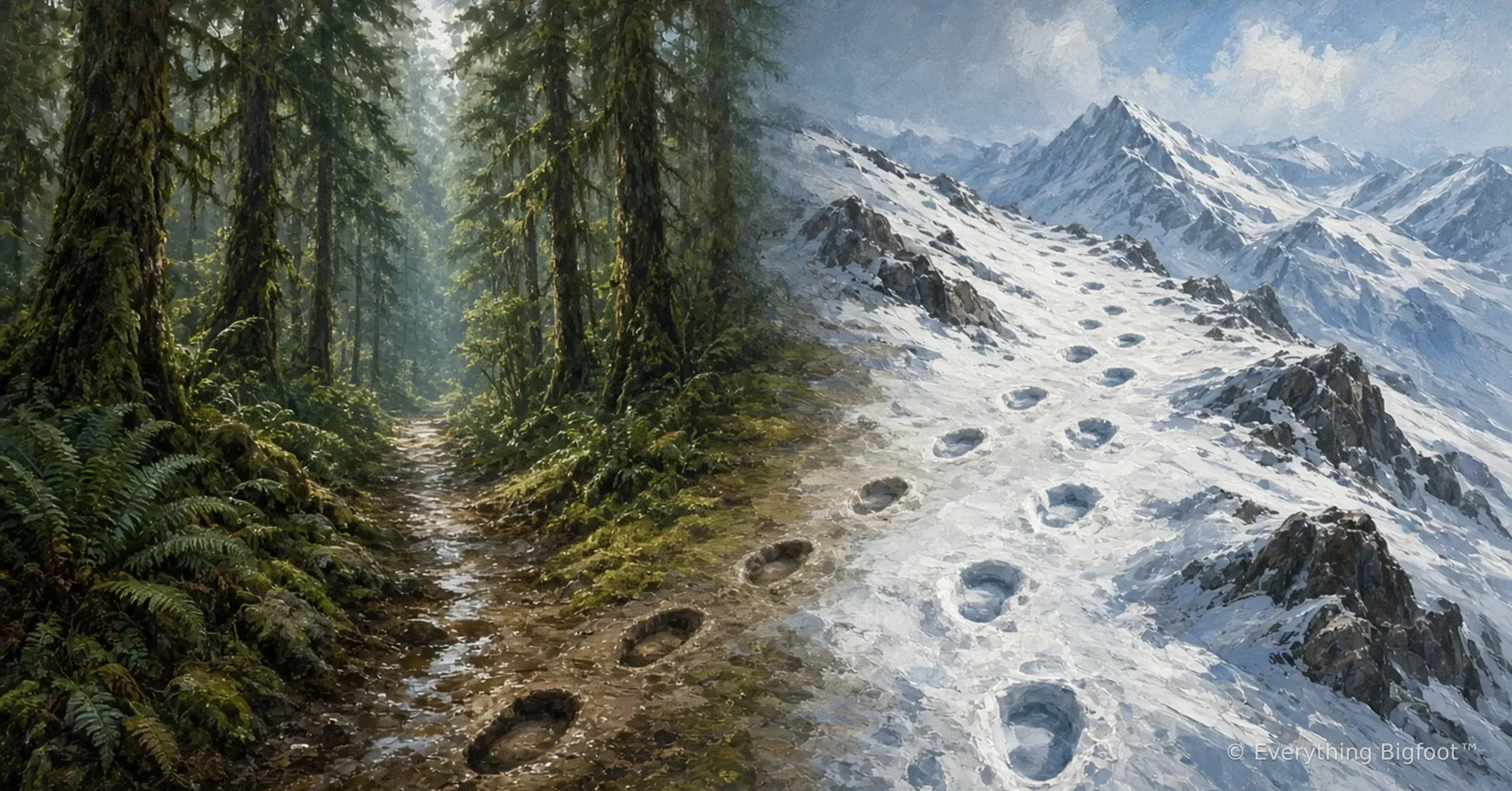
Welcome to Everything Bigfoot™, and happy New Year! We figured the best way to kick off 2026 is with the question we hear more than any other: is it Bigfoot, Sasquatch, or Yeti? Are those three different creatures, or one big hairy legend wearing three name tags?
Short answer: Bigfoot and Sasquatch are two names for the same North American legend. The Yeti is its cousin from the other side of the planet. The long answer is a lot more fun, so grab a cup of coffee and let's walk through it.
Sasquatch: the older name
Most people assume "Bigfoot" came first. It didn't. The word Sasquatch shows up decades earlier, and it started in British Columbia.
In 1929, a teacher and Indian agent named J.W. Burns published a collection of stories in Maclean's magazine. Burns lived and worked with the Sts'ailes people (then called the Chehalis First Nation). Those stories described hairy "wild people" who lived in the mountains. Burns is credited with coining the word Sasquatch. It's believed to be an anglicized form of sasq'ets, a word in the Halq'emeylem language that roughly means "hairy man."
According to Merriam-Webster, as summarized on Wikipedia, Sasquatch is a synonym for Bigfoot that predates it by about fifty years. In Canada, Sasquatch is still the everyday word.
Bigfoot: a 1958 newspaper headline
"Bigfoot" was born in a Northern California logging camp. In 1958, a bulldozer operator named Jerry Crew found huge, human-like footprints, about 16 inches long, in the mud of the Six Rivers National Forest in Humboldt County. His crew had been noticing odd tracks for a while and had started calling the culprit "Bigfoot."
Reporter Andrew Genzoli of the Humboldt Times picked up the story. On October 6, 1958, Crew appeared on the front page holding a plaster cast of one of the prints. Big papers around the country ran with it, and the name stuck.
There's a twist we'll cover in a later post. In 2002, the family of Crew's late coworker Ray Wallace revealed a set of carved wooden feet and said Wallace had made the tracks. The name outlived the prank, though. Today Americans use both words, and Bigfoot is the more common one in the US.
So, what does Bigfoot/Sasquatch look like?
Descriptions vary from report to report, but the classic picture goes like this:
- Upright and walking on two legs
- Roughly 6 to 9 feet tall in most accounts, with some claims going much higher
- Covered in black, dark brown, or reddish hair
- Broad shoulders, long arms, and little or no visible neck
- Huge footprints. Some claimed tracks are up to 24 inches long.
The legend is most closely tied to the Pacific Northwest, but reports come from almost everywhere in North America. The public database run by the Bigfoot Field Researchers Organization (BFRO) has reports from 49 states in the dataset we use on our sightings page.
The Yeti: the Himalayan cousin
The Yeti lives in a completely different part of the world: the Himalayan mountains of Asia. Its legend comes from Sherpa and Tibetan folklore.
The word "Yeti" is usually traced to Tibetan words meaning something like "rocky-place bear." That's a clue to one common explanation, that some Yeti stories come from bears seen in the mountains. Tibetan lore even describes different kinds of Yeti, from a huge, fierce black-furred one down to a small reddish one only a few feet tall.
The English nickname Abominable Snowman dates to 1921, and it started with a mistranslation. That year, Lieutenant-Colonel Charles Howard-Bury led the British Mount Everest reconnaissance expedition. Crossing a high pass, he found tracks he thought "were probably caused by a large 'loping' grey wolf." His Sherpa guides said they belonged to "The Wild Man of the Snows," which they called metoh-kangmi, roughly "man-bear snowman." Back in Darjeeling, a newspaper writer named Henry Newman interviewed the expedition's porters and translated metoh as "filthy," then swapped in "abominable." Newman later admitted the story "seemed such a joyous creation" that he sent it to newspapers. The name stuck.
Other Himalayan names don't translate exactly the same way. Migoi means "wild man," Michê means "man-bear," and Dzu-teh, "cattle bear," refers to the Himalayan brown bear. That's a lot of bears for a creature many people picture as an ape.
The Yeti's big decades
Like Bigfoot, the Himalayan legend got its biggest boost from footprints:
- 1951: While scouting Everest, mountaineer Eric Shipton photographed large prints in the snow, using an ice axe and a boot for scale. The photos are still debated. Some call them the best evidence ever found, while others say melting snow distorted ordinary tracks.
- 1953: Edmund Hillary and Tenzing Norgay reported seeing large footprints on their Everest climb. Hillary later dismissed Yeti reports as unreliable.
- 1954: The Daily Mail Snowman Expedition collected hairs from an alleged Yeti scalp kept at Pangboche monastery. Anatomist Frederic Wood Jones concluded they weren't from a scalp at all, and most likely came from the shoulder of a coarse-haired hoofed animal.
- 1960–61: Hillary's Silver Hut expedition borrowed another alleged scalp, from Khumjung monastery. Testing found it was probably made from the skin of a serow, a goat-like Himalayan animal.
Belief stayed strong in parts of the region for a while. In 1966, Bhutan even issued a stamp honoring the creature.
The DNA verdict
The science on the Himalayan side has gotten fairly specific. A 2017 analysis compared bear DNA from the region with hair and other samples said to be from Yetis. The samples turned out to come from a Himalayan brown bear, a Tibetan blue bear, an Asiatic black bear and, in one case, a domestic dog. Mountaineer Reinhold Messner had already argued in his 1986 book My Quest for the Yeti that the creature is really a Himalayan bear, which can walk upright or on all fours.
Yeti descriptions usually mention brown, gray, or white hair, and sometimes big teeth. That's a little different from the dark-haired forest giant of North American stories, and the setting is totally different: snowfields and high passes instead of fir forests and swamps.
Quick comparison
| Bigfoot | Sasquatch | Yeti | |
|---|---|---|---|
| Where | United States (and Canada) | Canada and the US | Himalayas, Asia |
| Name origin | 1958 California newspaper story | 1929 article by J.W. Burns, from Halq'emeylem sasq'ets | Tibetan words, often linked to "bear" |
| Typical look | Tall, dark-haired, upright | Same creature as Bigfoot | Brown, gray, or white hair |
| Other names | Wood ape, Skunk Ape, Grassman, and more | — | Abominable Snowman, Migoi, and others |
| Famous evidence | 1958 Bluff Creek tracks; 1967 Patterson-Gimlin film | 1929 Burns stories | 1951 Shipton footprint photos |
| Habitat | Forests, swamps, river bottoms | Coastal mountains and forests | High snowfields and passes |
Evidence: same problem, different mountains
The two legends have more in common than their hair. Both rest mostly on footprints, eyewitness stories and blurry images, and both have been tested with DNA.
On the North American side, the most famous piece of evidence is the Patterson-Gimlin film, shot on October 20, 1967, at Bluff Creek in Northern California. It runs just 59.5 seconds and is still being analyzed and argued about. (Some enthusiasts mark October 20 as "National Sasquatch Awareness Day.") On the DNA side, a 2014 study by the University of Oxford and Lausanne's Cantonal Museum of Zoology, published in the Proceedings of the Royal Society B, ran the first systematic genetic analysis of thirty hair samples suspected to come from Bigfoot-like creatures. Only one was of primate origin, and it was human.
So the pattern is the same on both continents: the stories are rich, the footprints are dramatic, and the lab results keep pointing to bears and other familiar animals.
Cousins around the world
Bigfoot and the Himalayan legend aren't the only members of the family. Folklorists point to similar tales of hairy, human-like wild people across the globe, including the Almas of Central Asia, the Yeren of China and the Yowie of Australia. Many scholars also trace part of the Bigfoot story to the European "wild man of the woods," a figure settlers carried to North America.
What about the Skunk Ape, Grassman and the rest?
America didn't stop at two names. Florida has the Skunk Ape, named for its legendary stink. Arkansas has the Fouke Monster of Boggy Creek fame. Ohio has the Grassman, Missouri has Momo, Louisiana has the Honey Island Swamp Monster, Virginia has the Woodbooger, and Arizona has the Mogollon Monster.
Some of these are basically regional nicknames for Bigfoot. Others come with their own distinct stories and descriptions. We'll be giving each of them their own post this year, and we're building a full, upcoming Bigfoot names by state guide too.
What do scientists say?
We love this stuff, and we also want to be straight with you. Mainstream science does not recognize Bigfoot, Sasquatch, or the Yeti as real animals. Researchers point to folklore, misidentified animals (especially bears), and hoaxes as the main explanations.
Many people, including some scientists, still find the question fascinating, and the legends have deep roots in many cultures. At Everything Bigfoot™ we celebrate the stories, the places, the festivals and the fun, and we always tell you where our facts come from.
The bottom line
- Bigfoot = Sasquatch. Same North American legend, two names.
- Sasquatch is the older word, from 1929, with roots in a Halq'emeylem term for "hairy man."
- Bigfoot comes from a 1958 California newspaper story about giant footprints.
- Yeti is a separate Himalayan legend, also known as the Abominable Snowman.
So next time someone at the campfire asks "Bigfoot or Sasquatch?", you can smile and say, "Yes."
Stick around this year. We've got festivals, road trips, museums, and regional legends coming your way. Welcome to Everything Bigfoot™.