Few Bigfoot legends have had as big an impact as the one from a tiny town in the southwest corner of Arkansas. The Fouke Monster sparked a local panic and a radio bounty, and then it inspired one of the most successful independent films of the 1970s.
Where is Fouke?
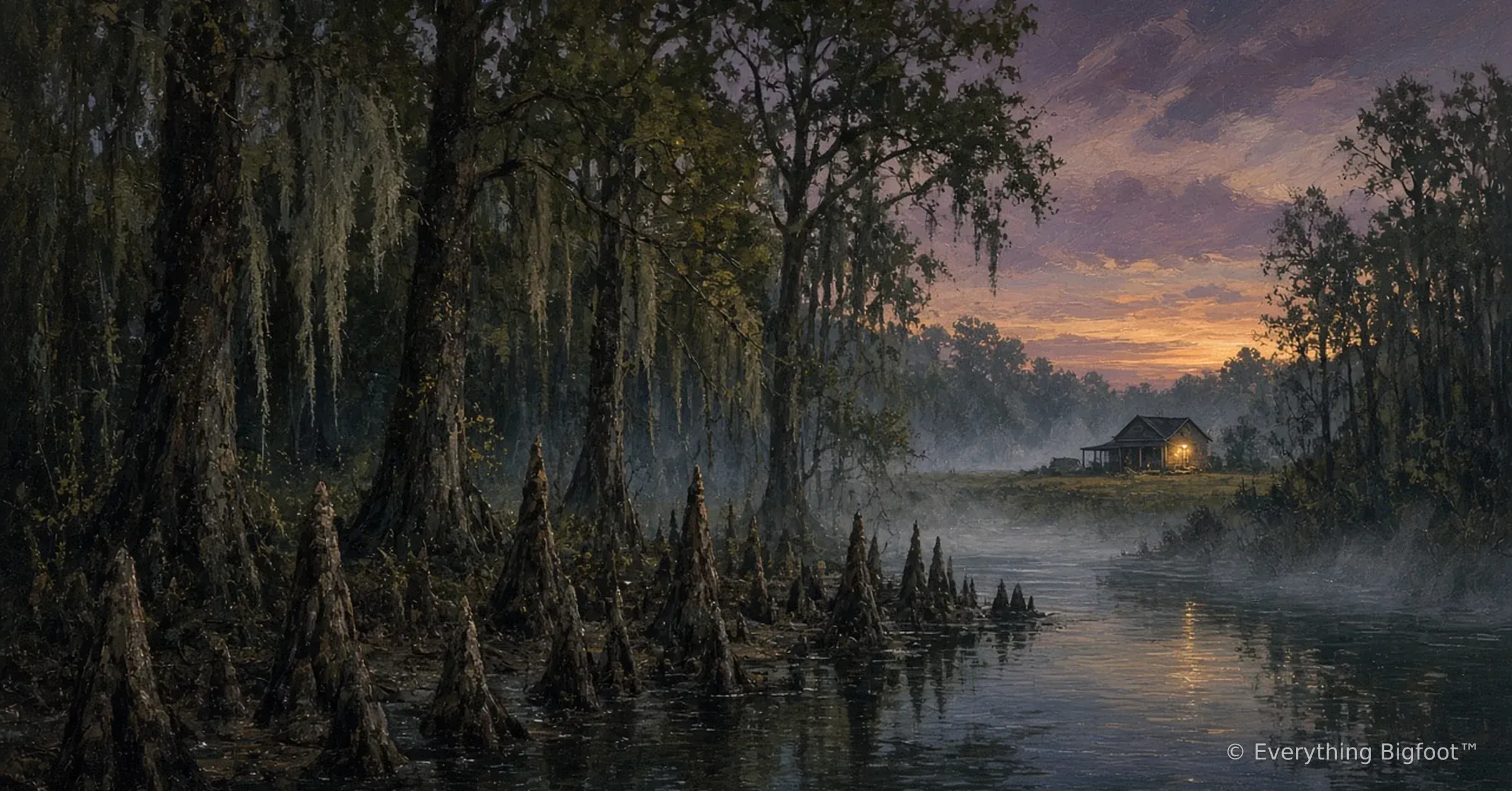
Fouke is a small town in Miller County, Arkansas, south of Texarkana, in swampy bottomland country. Boggy Creek and the Sulphur River area made the perfect backdrop for a legend. It's a small place: Fouke had a population of 810 in 2024, and it's part of the Texarkana metropolitan area that straddles the Texas–Arkansas line.
The legend before the headlines
According to Wikipedia, stories of a hairy creature in the area go back a long way. An 1851 report in the Memphis Enquirer and an 1856 report in the Caddo Gazette described a large, hairy creature in the general region. Locals have said sightings date back to 1946 and 1964. Many early reports came from near Jonesville, so the creature was once known as the "Jonesville Monster."
May 2, 1971: the Ford house
The Fouke Monster hit the headlines on May 2, 1971. Bobby and Elizabeth Ford had lived in their rented house outside Fouke for less than a week.
According to Elizabeth Ford's account, as summarized on Wikipedia, she was sleeping on a couch when something reached through a screen window. At first she thought it was a bear. Her husband Bobby and his brother Don chased it off and fired several shots, believing they'd hit it, but no blood was found. Searchers later found three-toed footprints near the house, along with scratch marks on the porch and damage to a window and siding.
May 23, 1971: crossing Highway 71
Three weeks later, on May 23, three people reported seeing an ape-like creature crossing U.S. Highway 71. More reports followed over the next months. One well-known set of tracks turned up in a soybean field owned by a local filling station owner. A game warden examined them but couldn't confirm they were genuine. Like the Ford prints, they appeared to show only three toes.
The monster gets a name and a bounty
Journalist Jim Powell, who covered the story for the Texarkana Gazette and Texarkana Daily News, is credited with naming the Fouke Monster.
As word spread, things got lively. Little Rock radio station KAAY posted a $1,090 bounty. Hunters showed up. Things got serious enough that Miller County Sheriff Leslie Greer put a temporary "no guns" policy in place to keep people safe.
What did it look like?
Reports from 1971 to 1974 described:
- About 7 feet tall and 250–300 pounds (one later witness claimed 10 feet and 800 pounds)
- Long dark hair
- A fast, galloping run with swinging arms
- A terrible odor, described as skunk mixed with wet dog
- Bright red eyes
Most famously, its tracks showed three toes. That's a strange detail, since primates have five, and it's become a signature of the legend.
The Legend of Boggy Creek (1972)
Here's where a local legend became a national phenomenon. Texarkana filmmaker Charles B. Pierce made The Legend of Boggy Creek, a docudrama that mixed staged interviews with local residents and reenactments of their encounters. Made for about $160,000, it was released on August 23, 1972.
It was a hit. Wikipedia reports it became the 11th highest-grossing film of 1972, a remarkable result for a tiny independent production. Pierce funded it with money from a local trucking company and hired local high school students to help finish it. Most of the cast were local people or Texarkana college students. Willie E. Smith, on whose land three-toed footprints were found, played himself, and many characters were named after the people who played them. Filming took place in Fouke, Texarkana and Shreveport, Louisiana. The working title was Tracking the Fouke Monster.
The film presents itself as a true story. Locals recount a reddish-brown, 7-foot creature with three-toed tracks and a foul odor, a farmer says it carried off two 100-pound pigs, and hunting dogs refuse to give chase. In the climactic sequence, drawn from the actual newspaper accounts, the creature menaces a family in a remote country house.
Today it's considered a cult classic, and it helped kick off a wave of Bigfoot movies in the '70s. Variety reported that it earned another $4.8 million in North American theatrical rentals in 1975. Reviews at the time were generally favorable; the Arkansas Gazette called its wilderness scenes "a visual feast" and said the film was "scary and charming." Director Daniel Myrick later cited it as an influence on The Blair Witch Project (1999). A remastered version premiered in 2019 after Pierce's daughter, Pamula Pierce Barcelou, acquired the rights.
The film wasn't universally loved in Fouke, though. Wikipedia notes that the production drew controversy over how the filmmakers treated some of the locals whose stories were used. The 1974 book Smokey and the Fouke Monster by Smokey Crabtree lays out those complaints. It's a good reminder that real people lived through these events.
Return trips to Boggy Creek
The 1972 film spawned a whole shelf of follow-ups, according to Wikipedia:
- **Return to Boggy Creek (1977):** directed by Tom Moore and starring Dawn Wells as a mother whose three children get lost in the swamp. Its plot was entirely fictional, and it wasn't meant as a sequel.
- **Boggy Creek II: And The Legend Continues (1985):* Pierce's own sequel, in which he played a University of Arkansas professor leading students into the swamps around Fouke. It was shot on location in Fouke, and Mystery Science Theater 3000* lampooned it in 1999.
- **Boggy Creek: The Legend Is True (2010):** an unrelated horror story set in a fictional Boggy Creek, Texas.
- **The Legacy of Boggy Creek (2011):* a low-budget docudrama first released in 2009 as The Skunkape Story*.
- **Boggy Creek Monster (2016):** a documentary filmed in Fouke, directed by Seth Breedlove and co-produced with author Lyle Blackburn under Breedlove's Small Town Monsters banner, featuring claimed eyewitness accounts.
What do skeptics say?
Investigators have offered ordinary explanations. Researcher Joe Nickell said a 1955 report from a 14-year-old boy, which described reddish-brown hair and an animal sniffing the air, matched a misidentified black bear. The three-toed tracks have also drawn skepticism. As with many famous cases, hoaxes and misidentification are the mainstream explanations.
Visiting Fouke today
Fouke embraces its monster. The Fouke Monster Festival is typically held in late April. The 2026 edition is listed for April 24–25, so check the official festival page for details. It's a great excuse for a southern road trip, and it's on our 2026 festival calendar.
Arkansas by the numbers
In the public BFRO dataset we use for our sightings map, Arkansas has 91 mapped reports, with the earliest from 1961. Miller County, home of Fouke, has five of them:
| Date in dataset | Report summary | Class |
|---|---|---|
| Fall 1996 | Large upright figure seen | A |
| Winter 2000 | Large upright figure seen | A |
| 2001 | Unusual sounds heard | B |
| Winter 2004 | Large upright figure seen while hunting | A |
| Summer 2012 | Large upright figure seen | A |
A few patterns stand out statewide:
- Arkansas has the highest Class A share of any state with 80 or more reports. 63 of its 91 reports (about 69%) are Class A clear sightings, against 27 Class B and one Class C. Alabama (66%) and Oklahoma (64%) come next. By contrast, about 42% of Washington's reports and 38% of California's are Class A.
- Fall leads with 31 reports, ahead of summer (26), winter (18) and spring (16). October (13) and November (12) are the busiest months.
- The 2000s were the peak with 36 reports. Seventeen date from 2010 or later.
- Reports are spread out. Baxter and Saline counties lead with six each, ahead of Pulaski and Hot Spring (five each) and Miller (five). Reports come from all over the state, not just the southern bottomlands around Fouke.
Want to go deeper?
- Book: The Beast of Boggy Creek by Lyle Blackburn is a deep dive into the Fouke Monster and the film. Find it in our upcoming best Bigfoot books list.
- Film: The Legend of Boggy Creek (1972) is the one that started it all. See more in our upcoming Bigfoot movies and TV roundup.
From a screen window in 1971 to drive-in screens across America, the Fouke Monster shows how one small town's story can become a piece of national folklore.