An Everything Bigfoot™ Campfire Tale: an original work of fiction. The people, places and events in this story are invented, and Lantern Lake is not a real lake. It is inspired by the kinds of sounds people commonly describe in Bigfoot reports, not by any real case.
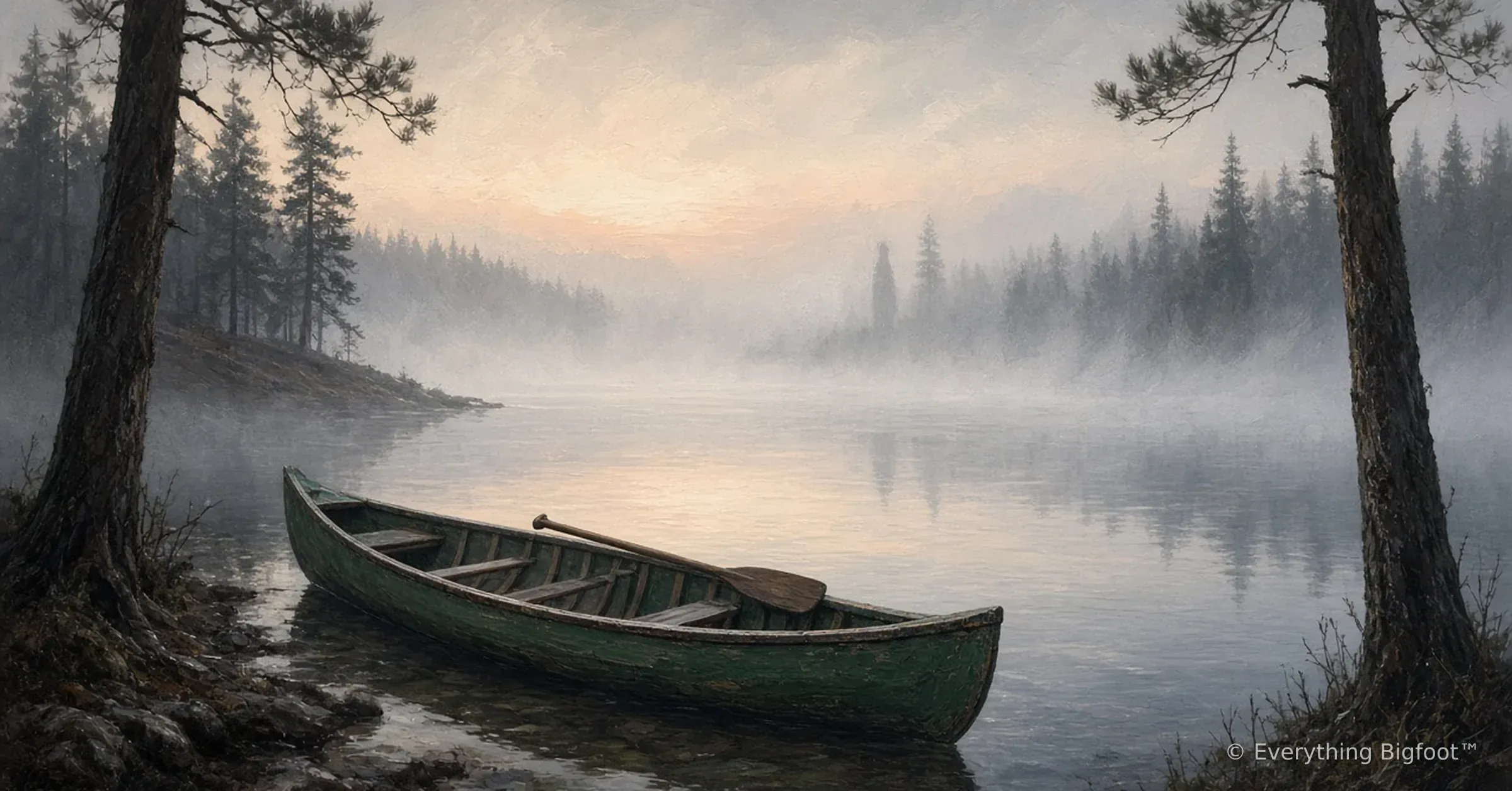
My sister June has always said the best fishing is in the first hour of light. She says it the way other people say "look both ways." So at 5:15 in the morning on the last Saturday of September, I was sitting in the front of a green aluminum canoe with a thermos between my knees, watching her push us away from the little gravel beach at Lantern Lake.
Lantern Lake isn't big. You can paddle the whole shoreline in about two hours if you don't stop. It sits in a bowl of steep hills covered in hemlock and pine, with one dirt road in and the same dirt road out. Our grandfather named it, as far as our family is concerned. He used to say that on calm nights, the lights from the three cabins on the east shore reflected so perfectly that the lake looked like it was holding lanterns.
The cabins are empty now. Two of them have caved-in roofs. The third belongs to us, and we come up twice a year to air it out and fish.
That morning the lake was black glass. No wind. Not a ripple. The sky over the eastern ridge had just started to turn gray, and a thin layer of mist was lying on the water like a sheet someone had shaken out and let fall.
"It'll burn off," June said, before I'd even asked.
The first splash
We paddled toward the north end, where a creek comes in and the bass hang around the drowned timber. The mist got thicker as we went. By the time we reached the dead trees, the shoreline thirty yards away had faded to a dark smudge, and the top of the ridge had disappeared.
June tied on a lure and made her first cast. The plop of it hitting the water sounded very loud.
Then, from somewhere off to our left, there was another splash.
It wasn't a fish jumping. I've heard a thousand fish jump. This was heavier, a deep ka-loomp, like someone had dropped a cinder block off a dock. The rings from it came rolling out of the fog a few seconds later and rocked the canoe gently.
"Beaver," June said.
"That was a big beaver."
"Big lake." She reeled in and cast again.
I watched the place the rings had come from. Fog. Nothing but fog.
Something on the shore
For a while, everything was ordinary. June caught a small bass and let it go. I poured coffee. A loon called somewhere far off, that long wobbling cry that always sounds like someone laughing at a funeral. The fog thickened instead of burning off. Soon I couldn't see the shore at all, only the dead trees standing up out of the water around us like the masts of sunken ships.
That's when I heard the footsteps.
They were on the shore to our left, in the same direction as the splash. Slow. Heavy. Two steps, then a pause, then two more. Something big was walking along the water's edge, and every few steps a branch cracked under it.
June heard it too. She stopped reeling.
"Deer," she said, very quietly.
Deer don't walk like that. Deer pick their way along. They step and stop and step and flick their tails. Whatever was on that shore walked like a person carrying something heavy, with long, deliberate strides. Two steps. Pause. Two steps.
Then it stopped.
We sat very still in the canoe. Water dripped off June's paddle. The fog was so thick now that it beaded on the sleeves of my jacket.
And from the shore, out of the white, came a sound I will never forget: two rocks, cracked together. Clack. Clack.
Keeping pace
"Let's go back," I said.
June didn't argue, which scared me more than anything else so far. She turned us around with three hard strokes, and we started paddling south, back toward the beach and the cabin.
We'd gone maybe fifty yards when the footsteps started again.
They were on our left still, on the west shore, and they were moving with us. When we paddled hard, they sped up, crashing through brush, splashing through the shallows. When June stopped to get her bearings in the fog, they stopped too.
Clack. Clack.
"It's following us," I whispered.
"It's an echo," June said. "Sound does strange things in fog."
But echoes don't splash. And echoes don't break branches.
I could smell it then. I don't know how else to describe it: wet dog, rotting leaves, and something sour underneath, like an old cellar. The smell drifted across the water and filled the canoe, and my eyes watered.
June paddled harder. The bow cut through the black water and the fog swirled around us. I kept looking left, toward the shore I couldn't see, and once, just once, I thought I saw a shape. It was tall, much taller than a man, and dark against the white, standing between two pale birch trunks. Then the fog shifted and it was gone.
The rock
We were about halfway home when the rock came.
It came out of the fog in a high arc. I heard it before I saw it, a whistle in the air, and then it hit the water ten feet in front of the canoe with a splash that soaked my knees. It was big, the size of a softball at least, and it had come from the shore.
June stopped paddling.
Neither of us said anything for a long moment. The rings from the rock spread out and lapped against the side of the canoe.
Then a second rock hit the water behind us. Closer.
"It's not trying to hit us," June said, in a strange flat voice. "If it wanted to hit us, it would have."
"Then what is it trying to do?"
She didn't answer. She turned the canoe away from the west shore, out toward the middle of the lake, where the water is deepest and the shore is farthest away on every side. And we drifted there, in the white, while the footsteps paced back and forth along the shore. Two steps. Pause. Two steps.
The lanterns
I don't know how long we sat out there. My watch said forty minutes, but it felt like hours. The footsteps never left. Every so often the rocks clacked together. Once there was a long, low sound that started like a groan and rose into something almost like a moan, and the hair on my arms stood straight up.
Then, slowly, the fog began to thin.
The sun was finally over the ridge. The white turned gold, then pale, and then it broke apart into ribbons and drifted off the water. And for the first time in more than an hour, we could see the shore.
It was empty. Just pines and birches and the gray rocks along the edge of the water.
But on the gravel beach in front of our cabin, where we'd launched the canoe at 5:15 that morning, there were rocks.
Someone had stacked them. Three little towers of flat stones, each about knee-high, lined up in a neat row along the waterline, right where the old lanterns used to sit on the dock our grandfather built.
June paddled us to the beach without a word. We pulled the canoe up and walked past the stacks without touching them. We packed the car in about ten minutes and drove out the one dirt road with the windows up.
Afterward
We haven't been back to Lantern Lake. June says we will, someday, when the cabin needs its roof checked.
I asked her once, a few months later, what she thought it was.
She was quiet for a long time. Then she said, "I think it was showing us that it was there first."
I think about those stacks of rocks a lot. Three of them. One for each cabin. As if, after all these years of seeing our lights across the water, it wanted to leave a lantern of its own.
---
About this story
This is a work of fiction written for the Everything Bigfoot™ Campfire Tales series. June, the narrator, their grandfather and Lantern Lake are all invented. Heavy splashes, rocks clacked together, thrown stones, strong smells and footsteps that keep pace are things people commonly describe in Bigfoot reports, and many of them have ordinary explanations like beavers, deer, falling rocks or sound bouncing strangely in fog. Our guide to Bigfoot sounds vs. animal sounds explains how to tell common forest noises apart.
Want another tale for the fire? Try The Knocks at Pine Ridge or The Whistle in the Hollow. And if you ever hear something real that you can't explain, our guide on how to report a Bigfoot sighting shows you what to write down.