You were driving a back road at dusk, or sitting in a deer stand, or hiking a quiet ridge, and you saw or heard something you can't explain. Now what?
Whether it turns out to be a bear, a hoax or a genuine mystery, a careful, honest record is the most useful thing you can create. Here's a simple step-by-step guide.
Step 1: Stay safe first
Before anything else:
- Don't approach or follow anything large in the woods. Plenty of real animals, such as bears, moose and feral hogs, can be dangerous up close.
- Get to a safe spot, like your vehicle, camp or a trail with other people.
- Don't trespass to go "check it out." Respect private property and posted land.
- Tell someone where you are if you're alone.
There's a sad reminder of why this matters. In December 2024, two Portland men who went looking for Sasquatch in Washington's Gifford Pinchot National Forest were found dead after a three-day search. The Skamania County Sheriff's Office said the deaths appeared to be from exposure, citing the weather and a lack of preparation. No sighting is worth that.
Step 2: Write it down right away
Memory changes fast, especially after an exciting or scary moment. As soon as you're safe, write down or voice-record:
- Date and time, as exactly as you can
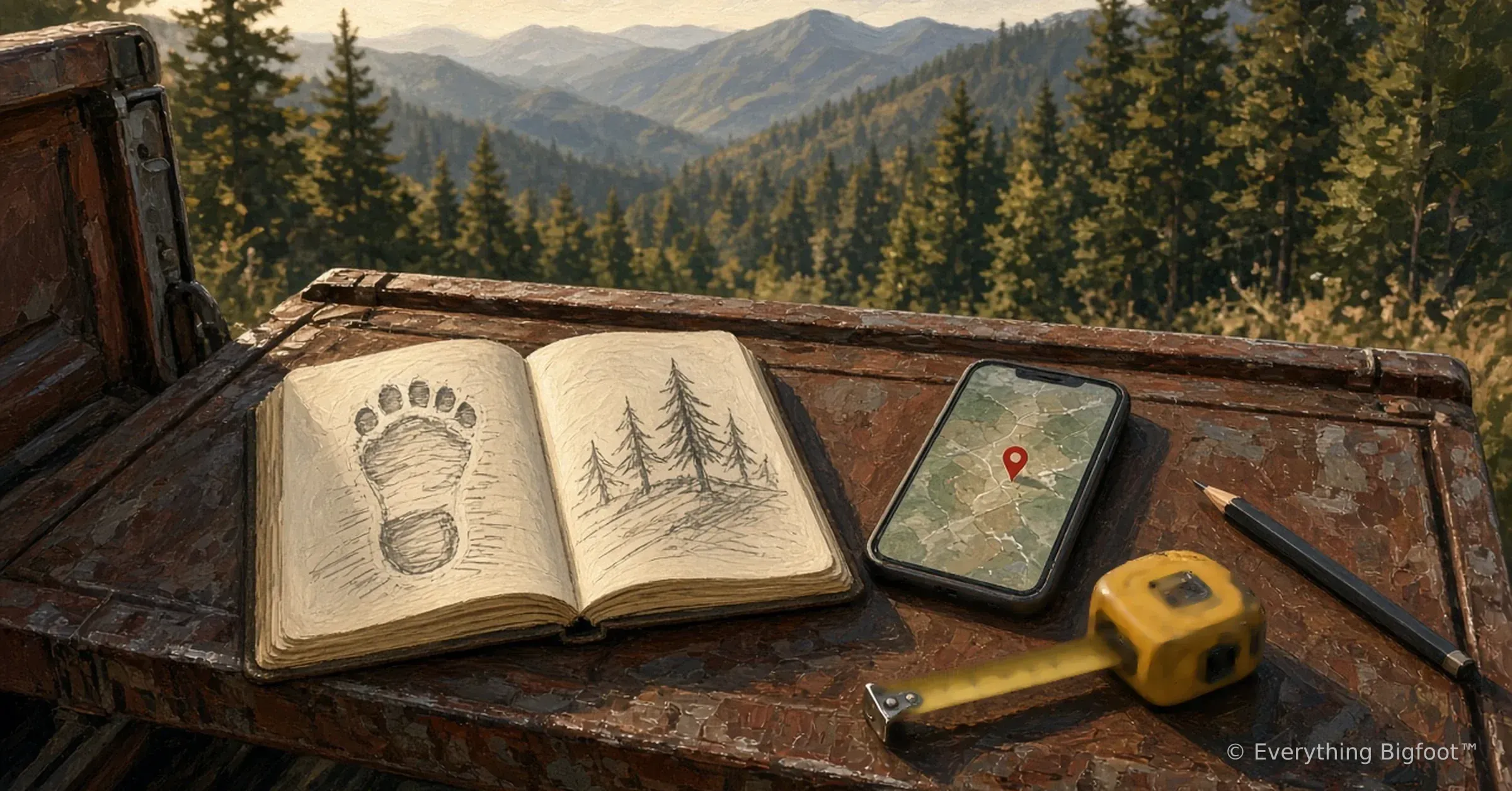
- Location: GPS coordinates from your phone if possible, plus the nearest road, town, trail or landmark
- Weather and light: sunny, overcast, dusk, moonlight, fog
- What you saw or heard, in plain words. Estimate size by comparing to nearby objects ("about as tall as the stop sign").
- How long it lasted and how far away it was
- What you were doing at the time
- Any other witnesses, and get their contact info
Try to keep your notes to what you directly observed. Write "a dark, upright shape crossed the road," not "a Bigfoot crossed the road." Investigators value clean, unembellished details.
Step 3: Document, don't disturb
If there are footprints, broken branches or other traces:
- Photograph everything with something for scale in the frame, like a boot, water bottle or tape measure.
- Take wide shots and close-ups. Wide shots show the setting, and close-ups show detail.
- Mark the GPS location of each item.
- Don't trample the area. Stay on one path in and out.
- Leave No Trace. Don't cut branches or dig up plants, and pack out anything you bring.
If you're going to try a plaster cast, do it only where it's legal and allowed. On public land, check the rules first.
Step 4: Understand Class A, B and C
The Bigfoot Field Researchers Organization (BFRO), which runs the largest public sighting database, assigns every report it posts a class. According to its classification page, the class is about the potential for misinterpretation, not how credible the witness is or how interesting the story is. An honest witness can still misread what they saw or heard, so the circumstances decide the class:
- Class A: clear sightings in circumstances where misidentification of other animals can be ruled out with greater confidence. Some very well-documented footprint cases also count as Class A.
- Class B: distant or poor-light views, or any situation without a clear view, plus all sound-only reports. Even the most compelling sound-only case is always Class B and never Class A, because without a visual it's much easier to misidentify a sound.
- Class C: most secondhand reports, any thirdhand reports and stories with untraceable sources. The BFRO says these are kept in its archives but are very rarely listed publicly. The exceptions are documented incidents from before 1958, before the word "Bigfoot" entered the American vocabulary, and sightings mentioned in non-tabloid newspapers or magazines.
Two points are worth knowing before you file. First, the BFRO says Class B reports are not considered less credible or less important than Class A; both are credible enough to show the public. Second, almost all reports in the database are firsthand. A secondhand report is occasionally added, but it's never Class A.
That explains the numbers. In the BFRO dataset we use for our sightings map, there are 2,015 Class A and 2,014 Class B reports, and only 16 Class C. Class A share varies a lot by state: among states with at least 80 mapped reports, Arkansas is about 69% Class A, while California is about 38%.
Step 5: Submit your report
The BFRO has an online submission form at bfro.net/GDB/submitfm.asp. It's worth reading through the whole form before you start, because it asks for a lot of detail. Here's what it covers:
- Your story: what was seen, heard or found, in your own words. If you had a visual, the form asks you to be as descriptive as you can about appearance and behavior.
- When: the year, season, month and, if you know it, the day, plus the time of day and the lighting and weather conditions.
- Where: the nearest town and the nearest road or highway, the state or province, the county, and directions to the spot. The form specifically asks for GPS coordinates if you can get them, and notes that location details won't be posted if they could cause problems.
- Environment: the habitat (pine forest, swamp and so on) and nearby landmarks such as a creek bottom, ridge or bridge.
- Witnesses: how many people were there and what everyone was doing just before.
- Anything else: other unusual things seen, found or heard before, during or after, and any similar incidents you've heard of in the same area.
- Contact information: at least an email address. The BFRO says contact details are not displayed on the site or shared with third parties, and you can ask for your whole report to be kept confidential.
Two practical tips from the form itself. It warns that it can time out if the page is open too long (about 30 minutes), so write your account in a separate document first and paste it in. That's another reason Step 2 matters. And if you only want to talk to a researcher, you can say so, and your report won't be posted on the site.
What happens next? The BFRO says none of the modern reports in its online database go public without some kind of investigation. Simpler investigations involve phone interviews and steps to verify the details. The most complex ones can include field searches with experienced trackers and wildlife biologists, surveillance projects, and lab analysis. If a witness can't be contacted and interviewed, the report isn't considered credible, so double-check that your email and phone number are right.
The BFRO is a volunteer organization, and it says response times vary, with priority given to the most recent incidents. Don't be discouraged if nobody calls right away. To check on a report you've already sent, or to correct something in it, use the BFRO's Comments page and refer to your report by the year, county and state of the incident.
Other research groups and local Bigfoot organizations accept reports too. Our upcoming guide to Bigfoot research organizations will list several.
A note about Everything Bigfoot™: our sightings page summarizes public BFRO reports and links back to the original. We don't take reports directly at this time. Please send your account to an established research organization.
Step 6: Consider other explanations
This isn't about doubting yourself. It's about making your report stronger. Ask:
- Could it have been a bear? Black bears stand on their hind legs and live in most of the regions where Bigfoot is reported. A 2009 study by Lozier and colleagues in the Journal of Biogeography modeled Bigfoot reports the same way biologists model a species' range, and found the conditions where Bigfoot is reported closely match those of the American black bear. The authors concluded that sightings, if not made up, are likely misidentified black bears.
- Could it have been a person? Hunters, hikers and, yes, pranksters in costumes all exist.
- Could the sound be an owl, coyote, fox or elk? Many night calls sound eerie if you've never heard them before. Barred owls, red foxes and elk can all produce surprising screams and whoops.
Investigators will ask these questions anyway. Answering them up front shows you're a careful witness.
Step 7: Be patient and keep your notes
Reports can take time to review. Keep your original notes, photos and GPS points backed up somewhere safe. Revisit the area only if it's safe and legal, and bring a friend.
Quick checklist
- [ ] Safe and accounted for
- [ ] Date, time, exact location (GPS)
- [ ] Weather, light, distance, duration
- [ ] Plain description of what you saw or heard
- [ ] Photos with scale, both wide and close-up
- [ ] Witness names and contacts
- [ ] Report submitted to a research organization
Want to see what other people have reported near you? Browse our sightings list or check out Bigfoot sightings by state. And if you're planning to head out on purpose, watch for our upcoming Bigfoot gear checklist.