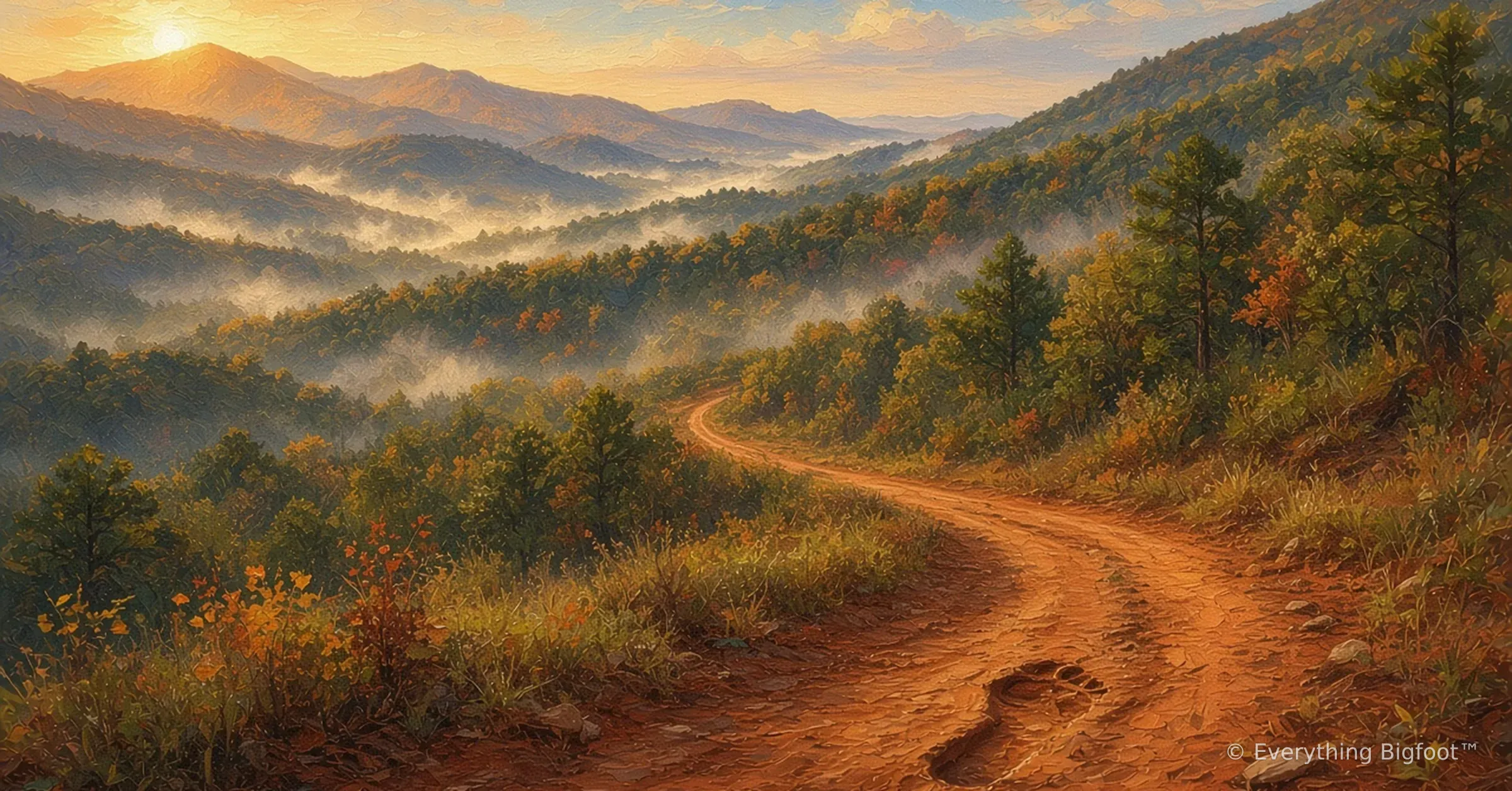
When people think about Bigfoot, they usually picture the Pacific Northwest. But ask anyone who has spent a night in the pine-and-oak hollows of southeastern Oklahoma, and you'll hear a different story. The Ouachita and Kiamichi Mountains have produced some of the most talked-about Bigfoot reports, festivals and research projects in the country.
This guide covers what the public data says, which places to visit, the events worth planning a trip around, and a comfortable base camp right at the edge of the forest.
Oklahoma by the numbers
We start every state guide with the public BFRO-based dataset that powers our maps. It's not a complete count of every Bigfoot report ever made. It's the reports one organization collected that have map coordinates. But it's a consistent way to compare places.
Oklahoma has 83 mapped reports in the public dataset (through 2021), dating from 1942 to 2021.
The top counties:
| County | Mapped reports |
|---|---|
| Le Flore | 20 |
| Caddo | 5 |
| McCurtain | 5 |
| Oklahoma | 3 |
| Cherokee | 3 |
| Comanche | 3 |
Le Flore County stands out. With 20 of the state's 83 entries, it has about a quarter of all of Oklahoma's mapped reports, and four times as many as any other county. That's the county that holds a big piece of the Ouachita National Forest, the Winding Stair Mountains and the town of Wister.
What the Le Flore County reports describe
The 20 Le Flore County reports run from 1971 to 2020. In the BFRO's classification system, 7 are Class A (generally, cases where a witness reports a clear observation) and 13 are Class B (usually sounds, tracks or an encounter without a clear view).
Here's how the reports break down by what was described:
- A large upright figure: 6 reports, two while hunting and one along a road (2012)
- Possible footprints: 4 reports, including one near water (2000) and one while hunting (1999)
- Unusual sounds: 3 reports, including one near a campsite (2004)
- A possible encounter without a clear view: 7 reports
The busiest stretch was the early 2000s. Between 1999 and 2005, the county logged 12 mapped reports. There are also clusters in 2012 (three reports) and a single report from spring 2020.
We don't add details beyond what the dataset contains, and you should treat every individual report as one person's account. Still, the pattern is interesting: a lot of the activity comes from hunters, which makes sense. Hunters sit still and quiet in the woods for hours, often at dawn and dusk.
For other states, see our Bigfoot sightings by state guide.
Why the Ouachitas?
The Ouachita National Forest is big, old and wild. According to Wikipedia, it covers about 1.78 million acres in Arkansas and Oklahoma. It was established on December 18, 1907, as the Arkansas National Forest and renamed in 1926, which makes it the oldest national forest in the South. Inside it, the Winding Stair Mountain National Recreation Area protects 26,445 acres in Oklahoma.
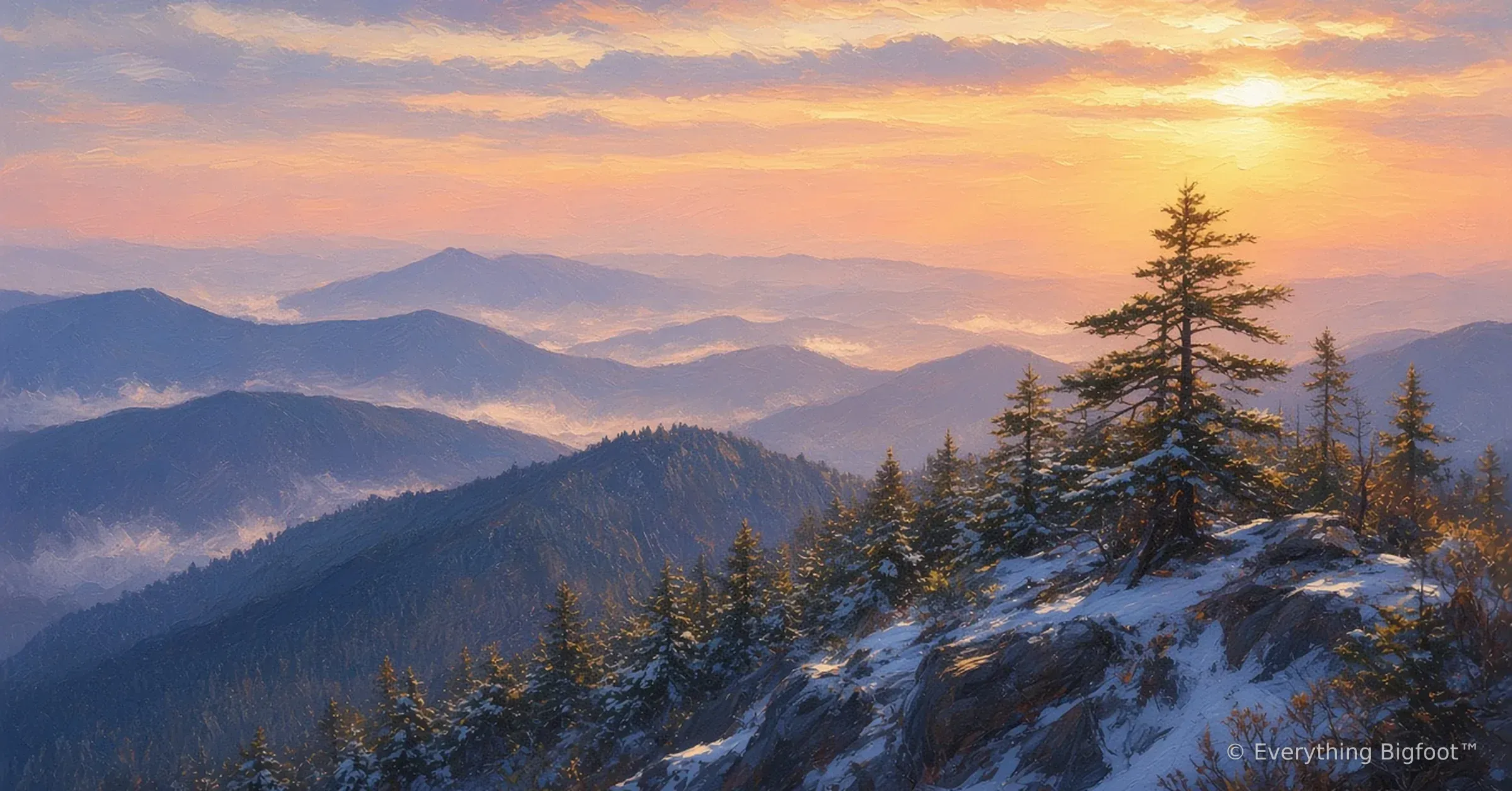
The Ouachita Mountains run east to west, which is unusual for North American ranges. To the south, the Kiamichi Mountains are a subrange of the Ouachitas. Wikipedia notes that the Kiamichis are home to black bears, bobcats, deer, coyotes, cougars and hundreds of other vertebrate species, and that large parts are owned by timber companies. The Talimena Scenic Drive between Talihina, Oklahoma, and Mena, Arkansas, is a favorite fall drive.
For Bigfoot researchers, that mix of steep ridges, thick timber, creeks and few people is exactly the kind of habitat that comes up again and again in reports.
The research angle: NAWAC and the Ouachita Project
The North American Wood Ape Conservancy (NAWAC) describes itself as an all-volunteer 501(c)(3) scientific-research organization that studies "the North American wood ape, the animal many people call 'bigfoot' or 'sasquatch.'" Its stated goal is to have the species documented and protected, along with the land it lives on.
On its homepage, the NAWAC points visitors to:
- The "Ouachita Project Monograph," which it describes as a detailed document about its long-term study efforts in its main area of operation
- "Tag 7," a technical report on a technique for attaching radio telemetry devices to its target species
- A catalog of recorded audio the group attributes to wood apes
- A database of historical reports and a report classification system
The NAWAC doesn't name the exact location of its study area on the homepage, and we won't speculate. Whatever you think of the conclusions, it's one of the most sustained field efforts in the Bigfoot world, and its name is tied to the Ouachita region. See our guide to Bigfoot research organizations for more groups.
Honobia: the Bigfoot festival in the Kiamichis
Deep in the Kiamichi Mountains, the community of Honobia has hosted an annual Bigfoot festival for years. Wikipedia's Honobia article mentions the event.
The current event is called "Bigfoot at the 40 Festival and Conference," held at Christ's 40 Acres near Honobia. According to the organizers' site, the 2026 dates were October 2–4:
- The front gate opens each day at 9:00 a.m. and closes around 10 p.m. The event ends at 5:00 p.m. on Sunday.
- A non-denominational worship service is held at 10 a.m. Sunday for those who want to attend.
- There's a free Kid-Zone at the new playground, a kiddy train ride, a trolley for parking transfers, and the Choctaw 5K and 1-mile runs.
- The conference has added more speakers, and there are more vendors and food vendors.
- Christ's 40 Acres is a drug- and alcohol-free, family-friendly zone. Dogs are welcome on a leash or under voice control.
The organizers also suggest making a long weekend of it "and enjoy all the beauty the Kiamichi Mountains have to offer as the leaves begin to change." Confirm the next year's dates on the official site before you go. You'll find it on our festivals map too.
Clayton: the Bigfoot Enigma Research Center and Museum
In the small town of Clayton, the Bigfoot Enigma Research Center and Museum offers exhibits, photographs, artifacts and casts, plus guided tours and workshops on tracking and evidence. The museum lists posted admission of $5 for adults, $3 for seniors and $10 for a family. Hours have been listed differently in different places, so call or check the museum's site before you drive out. Our Bigfoot museums guide covers others across the country.
A Bigfoot law that almost was
Oklahoma also made national news for a proposal that never became law. According to Wikipedia, in 2021 State Representative Justin Humphrey proposed an official Bigfoot hunting season to boost tourism. Under the idea, the Oklahoma Department of Wildlife Conservation would regulate permits, and the state would offer a $3 million bounty if a Bigfoot were captured alive and unharmed. It was meant as a tourism pitch, and it got plenty of attention. Read about the laws that did pass elsewhere in our upcoming Bigfoot laws and sanctuaries post.
Neighbors: Fouke and Texas
Southeastern Oklahoma sits close to two other famous Bigfoot regions. Fouke, Arkansas, home of the legendary Fouke Monster and The Legend of Boggy Creek, is about 170 road miles from Wister. Read our Fouke Monster guide. And the Piney Woods of East Texas, with their own long list of reports, are covered in Bigfoot in Texas.
Where to stay: Panorama Ranch, the gateway to the Ouachita National Forest
If you want to spend a few days in the heart of Le Flore County Bigfoot country, Panorama Ranch is our pick for a base camp.
Panorama Ranch is a whole 4-bedroom house on 160 acres outside Wister, Oklahoma, in Le Flore County. It bills itself as "the gateway to the Ouachita National Forest." From the gate, about a mile of dirt road leads to the national forest, which the ranch describes as about 220,000 acres of all-day UTV riding.
On the property you'll find:
- A fishing pond
- A hilltop view about a quarter mile from the house
- Private ATV trails
In the ranch's own words, it is "conveniently located between the 220,000 acre Ouachita National Forest, Wister Lake, Cedar Lake and Sardis Lake."
The Ouachita Ladder™
For riders and explorers, Panorama Ranch's owner created the Ouachita Ladder™, a route made up of five east-west roads and two north-south roads through the forest, designed for anyone visiting the Ouachitas. It's a great way to learn the backroads where so many of the area's hunters and campers spend their time. Get the details at panoramaranch.us/ouachita-ladder.
Road miles from Wister
Wister is a small town of 1,031 people (2020 census, per Wikipedia). Here's how far the area's highlights are from town, measured in road miles:
| Destination | Road miles from Wister |
|---|---|
| Wister Lake | 7.2 |
| Poteau | 8.8 |
| Heavener Runestone area | 12.2 |
| Talimena State Park | 22.9 |
| Talihina | 29.5 |
| Honobia (festival area) | 51.1 |
| Clayton (Bigfoot Enigma museum) | 54.5 |
| Broken Bow | 91.4 |
| Fouke, Arkansas | 170.1 |
Road miles are calculated with OpenStreetMap routing between town centers and are approximate.
Learn more and check availability at panoramaranch.us.
A sample long weekend
- Friday: Arrive at the ranch, fish the pond and catch the sunset from the hilltop.
- Saturday: Ride a section of the Ouachita Ladder™ through the national forest. Stop at Wister Lake on the way back.
- Sunday: Head south to the museum in Clayton, or time your trip for the early-October festival near Honobia.
Field tips for Ouachita Bigfoot country
- Go at dawn and dusk. Those are the hours the Le Flore County hunters were in the woods.
- Sit still and listen. Several of the county's reports involve sounds. Learn the difference between owls, coyotes and foxes with our upcoming Bigfoot sounds guide.
- Bring a notebook. Write down the time, place and weather the moment anything happens.
- Know your seasons. Fall hunting seasons bring a lot of people into the woods. Wear blaze orange when required.
- Respect private land and leave no trace.
The bottom line
With a quarter of the state's mapped reports, a well-known research project, a festival in the Kiamichis and a museum down the road, southeastern Oklahoma has earned its place on any Bigfoot road trip. Base yourself near Wister, ride the Ouachita Ladder™, and spend a few evenings listening to the hollows.
Dataset counts come from the public BFRO-based TidyTuesday dataset (through 2021). Event dates and museum prices change, so always confirm with the organizer before you travel.