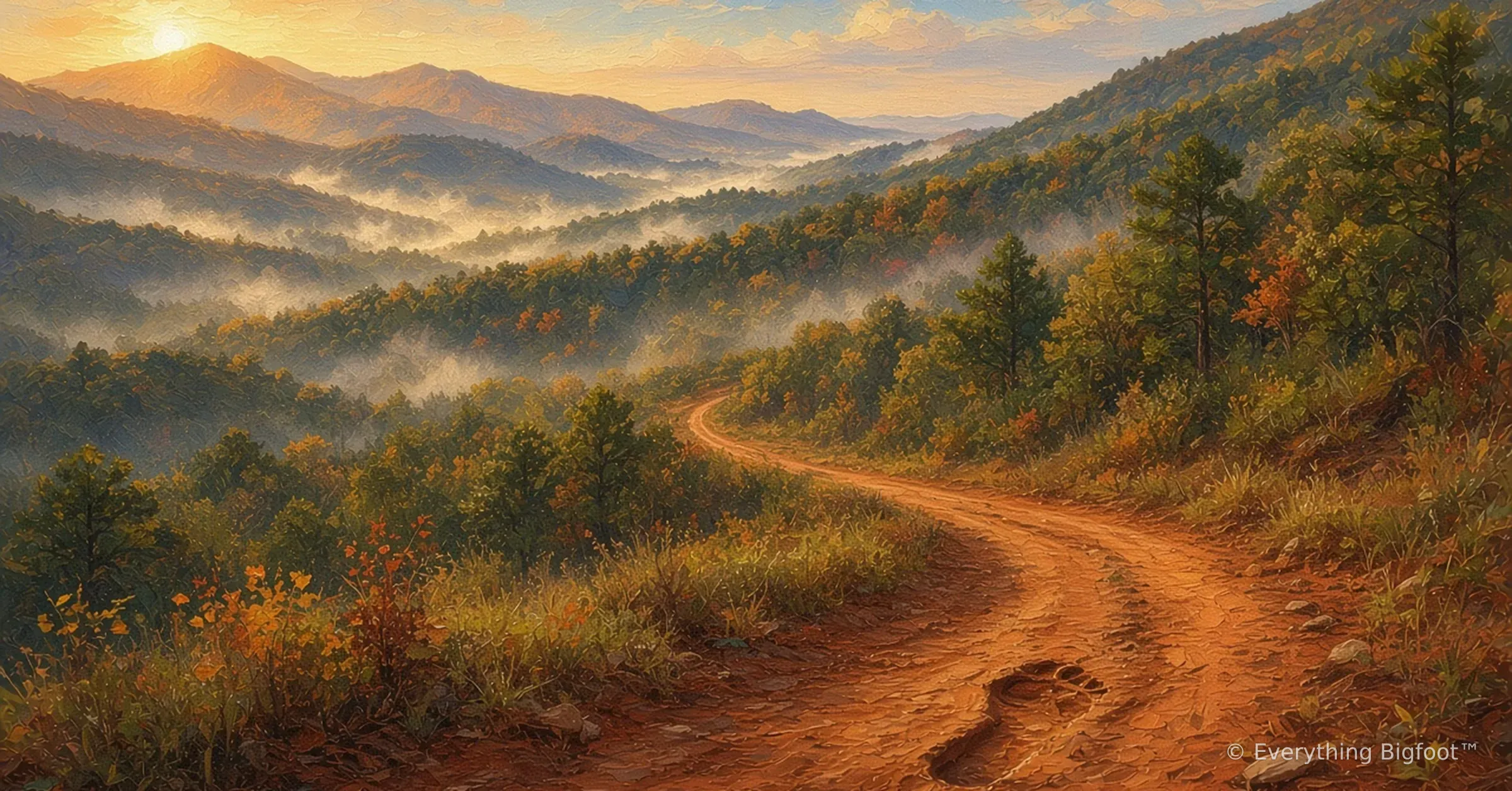
New Jersey is the most densely populated state in the country, and most people picture turnpike exits and shore towns long before they picture a forest giant. But two corners of the Garden State keep turning up in Bigfoot report files year after year: the high, rocky ridges of Sussex County in the far northwest, and the sandy, pine-scented wilderness of the Pine Barrens in the south.
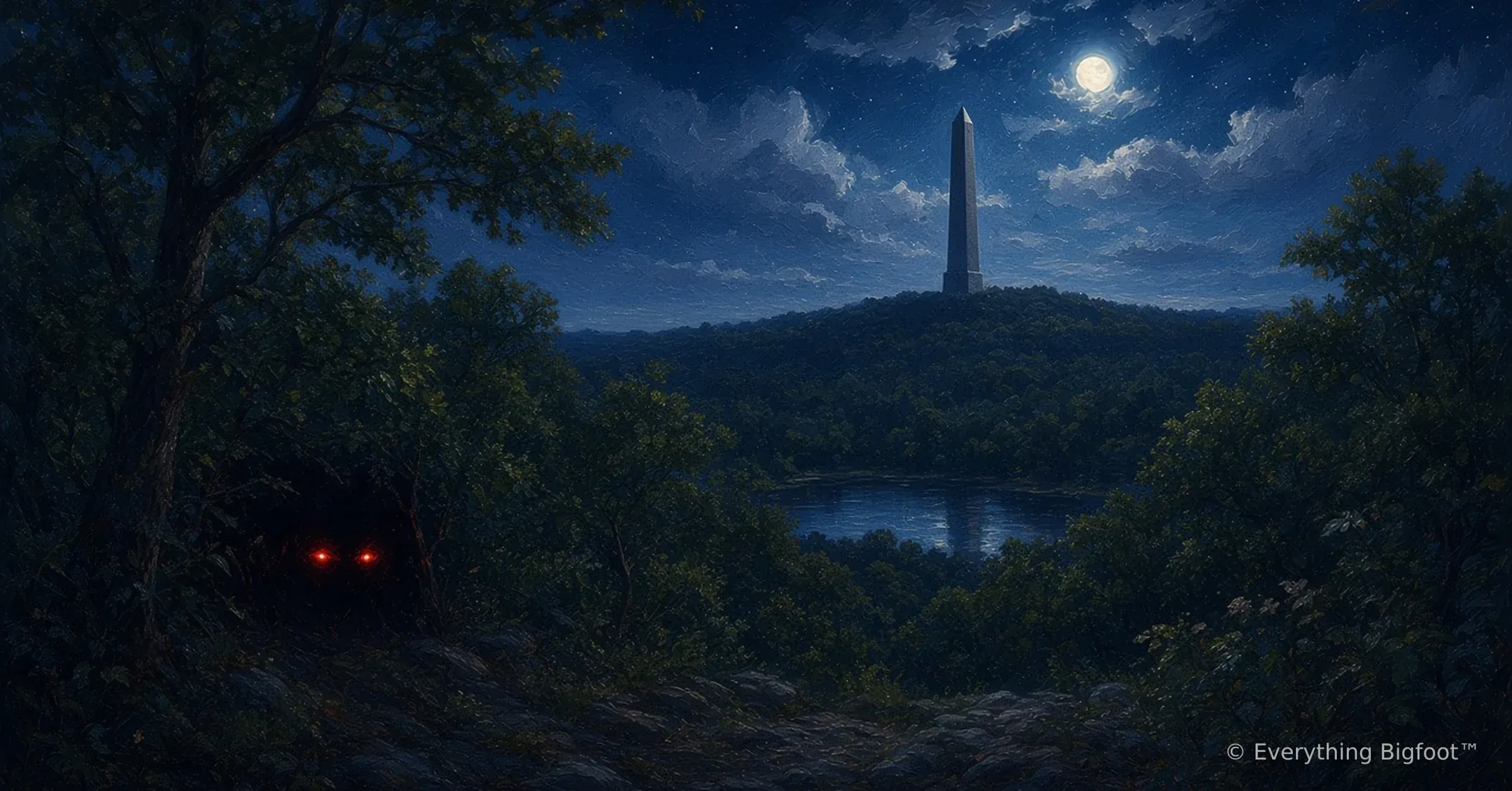
Locals in the north even have their own name for the creature. They call it Big Red Eye.
This guide covers the public data, the legend, the newest reports and the places researchers are watching now, with sources for every fact.
New Jersey by the numbers
Our maps use a public dataset of Bigfoot Field Researchers Organization (BFRO) reports that carry map coordinates. It is not every report ever made, but it is a consistent yardstick.
New Jersey has 43 mapped reports in the public dataset (through 2021), dating from 1971 to 2019.
| County | Mapped reports |
|---|---|
| Sussex | 9 |
| Burlington | 7 |
| Ocean | 5 |
| Morris | 5 |
| Passaic | 3 |
| Warren | 3 |
| Essex, Somerset, Salem | 2 each |
| Mercer, Monmouth, Middlesex, Hunterdon, Cape May | 1 each |
A few patterns stand out:
- Two clusters, not one. Sussex, Morris, Passaic and Warren in the northwest account for 20 of the 43 mapped reports. Burlington, Ocean and the other southern counties account for most of the rest.
- Clear sightings are common. 18 of the 43 are Class A reports, meaning the witness described a clear view. The other 25 are Class B, such as sounds, a partial view or something seen at a distance.
- The 2000s were the busy decade. 21 mapped reports fall in the 2000s, 11 in the 2010s, five in the 1990s, one in the 1980s and five in the 1970s.
- Summer and fall lead. 16 reports came in summer, 13 in fall, eight in spring and six in winter.
The BFRO's live listing is larger because it includes reports without coordinates and reports filed after 2021. As of this fall, the BFRO lists 79 New Jersey reports, with Sussex County on top at 18, followed by Burlington at 16, Ocean at 11, Morris at 6 and Warren at 5. The same two regions lead in both counts.
Big Red Eye: the Sussex County legend
The northwest corner of New Jersey sits on the Kittatinny Ridge, part of the Appalachian chain, and it is where the Big Red Eye legend lives.
In a 2011 report from Newtown, CBS New York described the creature as "an enormous, shadowy creature with a terrifyingly loud voice ... and big red eyes," and noted that reports "go back to the 1970s in places like High Point State Park." The station interviewed retired forest ranger Tom Card, who said he heard a frightening sound in the woods while on duty in the 1970s and then saw two other rangers, armed, hurrying away from the noise. "It was a wailing, howling kind of a scream, kind of a sound," Card said. "They were a little unnerved because they had never heard anything like this either." Card told the station he did not know what it was.
That same report mentioned a festival for Big Red Eye being held in Wantage Township, a sign of how deeply the legend has settled into local culture.
Weird NJ has printed a series of reader accounts that fill in the picture. One reader described two weeks in 1977 when "strange moaning sounds and eerie haunting screams filled the night along Wolfpit Road in Sussex County," starting around 2 a.m. and lasting until nearly dawn. A neighbor, JD Grant, told the reader it was "this horrible, blood curdling wailing sound" and that she had heard coyotes, bears and foxes and "it wasn't like anything."
Grant also described a 1996 walk along Layton Road when she and a friend came upon something standing near the roadside. "I knew it wasn't a bear, it was too lean and upright; it was humanoid," she said. "It was tall and shaggy with red eyes. The eyes were glowing red from reflected light, not glowing like LED lights."
The same reader, digging through old newspaper clippings, found a 1975 account of a forest ranger on a Sussex County trail who encountered a creature "about eight feet tall with big red eyes," and reported hearing that the Big Red Eye name grew out of run-ins with High Point State Park rangers.
A note for careful readers: red "glowing" eyes in nighttime reports are almost always eye-shine, light from a headlight or flashlight bouncing back from the eye. Many animals have it. Grant herself made that distinction. Height and posture tell you far more.
The Pine Barrens: Bigfoot in Jersey Devil country
Southern New Jersey holds a very different kind of wilderness. The Pine Barrens, also called the Pinelands, is the largest remaining example of the Atlantic coastal pine barrens ecosystem and stretches across more than seven counties. Its sandy, acidic soil kept farms away for centuries.
The numbers back up the region's reputation. Burlington and Ocean counties, both deep in the Pinelands, are two of the top three counties in the BFRO's New Jersey listing. And the three most recent reports on the BFRO's state page all come from here:
- June 2018, Burlington County (Class B): a snake researcher connected to government work describes a daytime encounter in Pine Barrens swamps.
- June 2019, Burlington County (Class A): a motorist reports a juvenile sasquatch near the Speedwell entrance to the Franklin Parker Preserve.
- November 2024, Ocean County (Class B): a hiker reports a possible sighting in the Pine Barrens about 5 miles southwest of Beachwood.
The Franklin Parker Preserve is an 11,379-acre preserve in Chatsworth that links Brendan Byrne, Wharton and Penn State Forests. Wharton State Forest alone covers roughly 122,880 acres, the largest single tract in New Jersey's state park system.
Sound is a big part of the Pinelands story too. Jacob Korbel, an investigator with the BFRO who has said he started out as a skeptic, joined an expedition in the Pine Barrens in 2021. As quoted by The Independent from his interview with NJ.com, he described "this whoop response" about 100 yards away: "right away, I'm like, that's nothing that I've ever heard before. That's not an owl, that's not a coyote, fox." He added that "you could hear it slowly getting closer to our position, like it was coming in to check us out."
The Pine Barrens even made it to cable TV. Finding Bigfoot devoted a 2014 episode, "South Jersey Sasquatch," to the region. It aired January 26, 2014, as season 4, episode 11, with Cliff Barackman and James "Bobo" Fay on the team.
Not the same as the Jersey Devil
Any Bigfoot conversation in the Pinelands eventually bumps into the state's most famous monster, so let's be clear: the Jersey Devil is a separate legend and not a Bigfoot story.
The Jersey Devil grew out of "Leeds Devil" folklore tied to the Leeds family of colonial South Jersey. The popular image, a winged, hoofed, dragon-like creature, was set during a famous wave of newspaper reports in the week of January 16–23, 1909, when hundreds of claimed encounters were published across South Jersey and the Philadelphia area. Some 1909 "evidence" was later admitted to be faked.
Bigfoot reports from the Pinelands describe something very different: a large, upright, hair-covered primate, the same basic description you hear in Oregon or Ohio. The overlap is geographic, not biological.
The 2026 picture: new recordings, new expeditions
New Jersey Bigfoot research is having a moment this fall.
In the Shadow of Big Red Eye. Researcher Mike Familant documents investigations in an online series named after the northern legend. As reported by The Independent on October 30, 2026, Familant points to the forests around High Point State Park, Stokes State Forest and the Delaware Water Gap as some of the state's hotspots. He told NJ.com about a sound his team recorded at High Point in 2022 after imitating an owl call. According to Familant, a military linguist reviewed it and "came back with a report that said it was outside of human vocal range and wasn't any known animal from northwestern New Jersey." The recording has not been published in a peer-reviewed venue, so treat it as one investigator's report.
The BFRO's 2026 Northern New Jersey Expedition. The BFRO scheduled an expedition in northern New Jersey for October 22–25, 2026, led by Larry Rippon and Scott Osborne, who have led or assisted several BFRO trips in the state. The BFRO's announcement calls northern New Jersey "one of the parts of the country that is usually overlooked as a bigfoot area," and points to the Appalachian Trail, which passes through this part of the state, as a key green corridor. It also notes that the area has "many black bears and deer," which matters for anyone evaluating a report there.
A TikTok from Lacey Township. On October 29, 2026, Ocean County radio station 92.7 WOBM wrote about a TikTok video that its poster said showed Bigfoot walking in the Pine Barrens in Lacey Township. The writer was openly skeptical, guessing a bear on its hind legs was more likely.
Where to look in New Jersey
Follow park rules, stay on marked trails and never trespass on private property.
The northwest ridges
- High Point State Park (Sussex County): 15,413 acres on the Kittatinny Mountains, including High Point itself, the highest spot in New Jersey at 1,803 feet. This is the heart of Big Red Eye country.
- Stokes State Forest (Sussex County): 16,447 acres of mountainous woods that run from High Point's southern edge toward the Delaware Water Gap.
- Delaware Water Gap National Recreation Area: about 70,000 acres along a 40-mile stretch of the Delaware River, managed by the National Park Service in New Jersey and Pennsylvania.
- The Appalachian Trail: the roughly 2,200-mile trail runs along the Kittatinny Ridge through all three of the places above.
The Pinelands
- Wharton State Forest: about 122,880 acres of pine forest in Burlington, Camden and Atlantic counties.
- Franklin Parker Preserve: 11,379 acres in Chatsworth, including the Speedwell area named in the 2019 report.
- Brendan Byrne and Penn State Forests: linked to Franklin Parker, together forming a long corridor of protected woods.
Field tips for New Jersey
- Know your bears. New Jersey has a healthy black bear population, especially in the northwest. See is Bigfoot real for how researchers rule out look-alikes.
- Record sounds, not just photos. Many New Jersey reports are about sound. Our Bigfoot sounds guide compares calls with owls, foxes and coyotes.
- Write it down fast. Note time, place and weather, then use our guide on how to report a Bigfoot sighting.
- Go with a group. The pinelands are easy to get lost in. The research organizations guide lists groups that run organized outings.
What New Jersey adds to the bigger picture
If a large, unknown primate could survive anywhere in the crowded Northeast, it would be in exactly the two places where New Jersey's reports cluster: the Appalachian green belt of the Kittatinny Ridge and the vast, lightly settled Pinelands.
At the same time, polling suggests belief is far from universal. The Independent cited a 2012 Angus Reid Public Opinion survey in which 29 percent of Americans said Bigfoot is "definitely" or "probably" real.
For more, see our guides to Appalachian Bigfoot, Bigfoot names by state and Bigfoot sightings by state. Our Bigfoot movies and TV shows roundup covers Finding Bigfoot.
Keep your recorder charged and your eyes on the ridge line. Big Red Eye has been out there since at least the 1970s, and New Jersey is still listening.