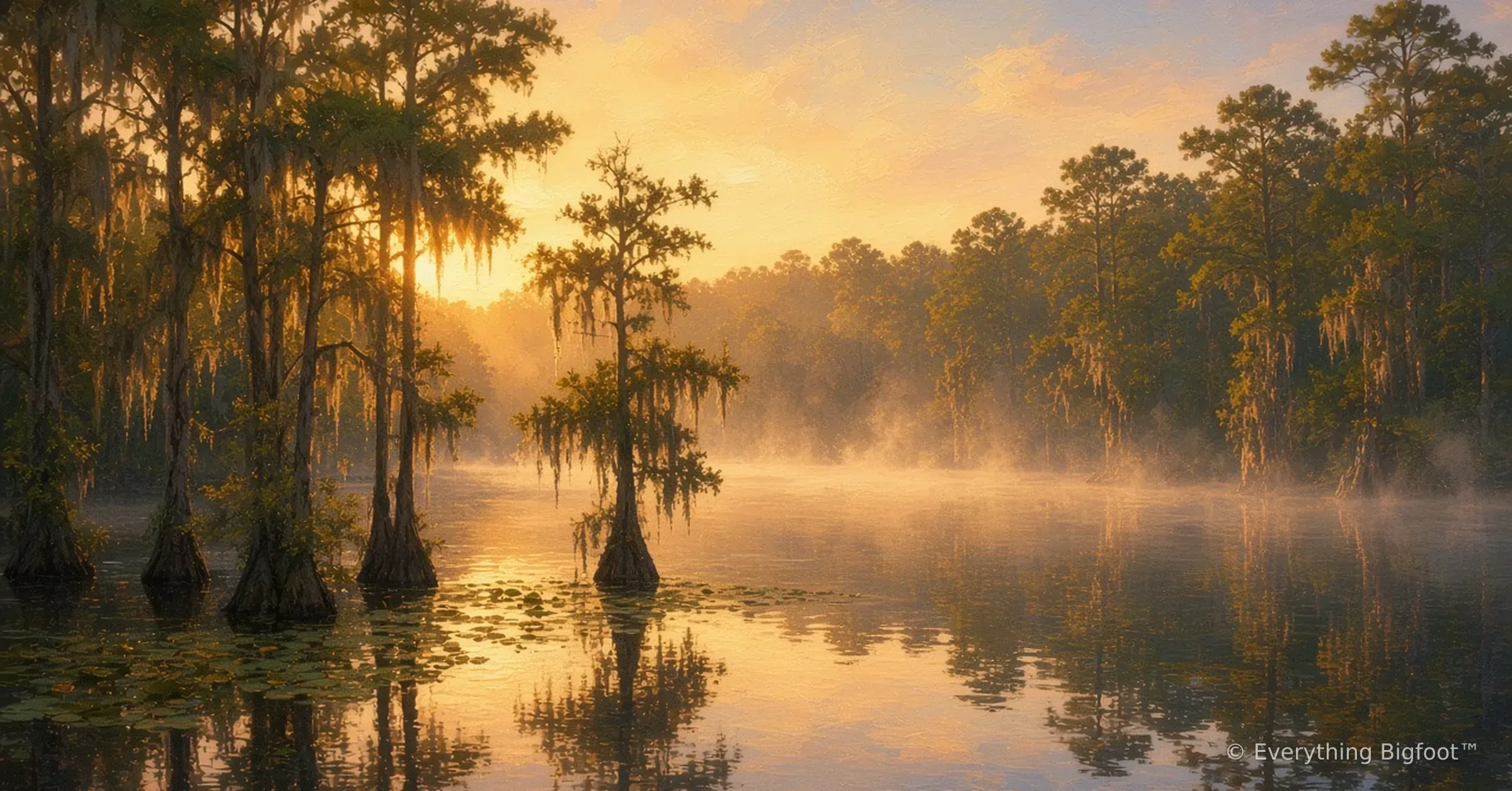
Everything's bigger in Texas, and that includes the Bigfoot stories. In the public BFRO dataset behind our sightings map, Texas has 218 mapped reports, with the earliest dating to 1930. That makes Texas fifth in the country in the dataset, behind only Washington, Ohio, Florida and California.
But here's the surprise: almost none of those reports come from the desert or the plains. Texas Bigfoot country is green, wet and full of pine trees.
The Piney Woods: Texas Bigfoot central
Look at the top Texas counties, and a pattern jumps out:
| County | Mapped reports | Region |
|---|---|---|
| Liberty | 9 | Big Thicket area, northeast of Houston |
| Cass | 9 | Far northeast Texas, near Arkansas |
| Rusk | 8 | East Texas |
| Montgomery | 8 | Sam Houston National Forest area |
| Parker | 8 | West of Fort Worth |
| Harrison | 7 | Caddo Lake area, near Louisiana |
| San Jacinto | 7 | Sam Houston National Forest area |
| Jasper | 6 | Deep East Texas |
(Mapped reports in the public dataset through 2021, not total BFRO reports.)
Most of these counties are in the Piney Woods of East Texas, a huge region of pine and hardwood forest, river bottoms, swamps and lakes that stretches into Louisiana, Arkansas and Oklahoma. It's the same kind of country that produced Arkansas's famous Fouke Monster, just across the state line from Cass County.
The area includes four national forests (Sabine, Angelina, Davy Crockett and Sam Houston) and the Big Thicket National Preserve, plus thick bottomland forests along the Trinity, Neches and Sulphur rivers.
- Sam Houston National Forest sits about 50 miles north of Houston, across parts of Montgomery, San Jacinto and Walker counties. Two of those counties, Montgomery (8) and San Jacinto (7), are in the state's top eight for mapped reports. Texas's four national forests and two national grasslands are run together from offices in Lufkin.
- Big Thicket National Preserve was established by the National Park Service in 1974 and is recognized by UNESCO as a biosphere reserve. Wikipedia calls the Big Thicket historically the densest forest region in Texas, with at least eight ecosystems, more than 500 vertebrate species and more than 160 kinds of trees and shrubs. Liberty County, tied for the most Texas reports, is on its western edge.
- Caddo Lake is a 25,400-acre lake and bayou on the Texas–Louisiana line, in Harrison and Marion counties. It's named for the Caddo people, who lived in the area until the United States forced them west in the 19th century.
When Texas reports happen
Texas breaks the usual pattern. In most states, summer is the busiest season. In Texas, it's the cool months:
- Fall leads with 68 reports, and winter is close behind with 61. Summer has 54 and spring 35. October is the busiest month (29), followed by December (27) and November (25).
- Most are Class A. 128 Texas reports are clear-view Class A sightings, more than the 88 Class B reports (distant or poor-light views, plus all sound-only reports). Two are secondhand Class C reports. That's the opposite of the West Coast states, where Class B reports lead, and about 59% of Texas reports are Class A, one of the highest shares among the top five states.
- The 2000s were the peak, with 125 reports, compared with 39 in the 2010s. Forty-two Texas reports date from 2010 or later, more than California or Oregon.
The cool-season lean fits East Texas. It's when deer season brings hunters into the woods, and when the heat, bugs and snakes finally back off.
The "wood ape"
In Texas, you may hear Bigfoot called a "wood ape." The term is closely tied to the North American Wood Ape Conservancy (NAWAC), a volunteer nonprofit that researches the animal many people call Bigfoot or Sasquatch and seeks protection for it.
NAWAC has deep Texas roots. According to the group, it was formerly the Texas Bigfoot Research Conservancy (TBRC) and took its new name in March 2013. Its history goes back to the Texas Bigfoot Research Center, co-founded in 1999 by Craig Woolheater. Learn more about groups like this in our guide to Bigfoot research organizations.
The Lake Worth Monster (1969)
Texas's most famous creature legend isn't from the Piney Woods at all. It's from the edge of Fort Worth.
In July 1969, people reported seeing "a half-man, half-goat, with fur and scales" around Lake Worth, at what's now the Fort Worth Nature Center and Refuge. Newspapers ran with it. According to Wikipedia:
- One report said the creature jumped out of a tree onto a man's car.
- Another said it threw a car tire at a group of people.
- A local named Allen Plaster took a photo of a man-sized "white furball," and crowds began driving out to the lake at night hoping to see it.
Police investigated and found no evidence. And when the reports stopped as school started back, many people suspected high school pranksters. Years later, Plaster himself said he believed it was a prank: "whatever it was, it wanted to be seen." In 2005, a Fort Worth Star-Telegram reporter received an anonymous letter from someone who claimed that he and two classmates had gone out to Lake Worth in the summer of 1969 to "scare people" with a tinfoil mask.
Not everyone agrees. Craig Woolheater has said he believes the Lake Worth Monster is an "undiscovered, uncataloged primate species that walks on two legs."
Today the legend is all in fun. Since 2009 (the 40th anniversary), the Fort Worth Nature Center and Refuge has held a Lake Worth Monster Bash each October.
The Texas Bigfoot Conference in Jefferson
Every fall, Bigfoot fans head to the historic town of Jefferson, near Caddo Lake in Marion County, for the Texas Bigfoot Conference. It's held at the Jefferson Tourism & Visitor Center and is usually the third weekend of October. Expect speakers, vendors, and plenty of East Texas stories. Check the official page for this year's dates and tickets, and see our festivals page for more events.
Jefferson makes a great weekend trip on its own: a historic downtown, riverboat tours and the eerie cypress swamps of Caddo Lake, one of the most beautiful (and Bigfoot-friendly-looking) places in the South.
Why East Texas?
Researchers who look for Bigfoot in Texas point to the same things they look for everywhere: big stretches of forest, plenty of water, and lots of food like deer, wild hogs, fish and nuts. East Texas has all of it, plus thick, swampy bottomlands where few people go.
Skeptics point out that East Texas also has black bears (in small numbers), wild hogs, and plenty of hunters with game cameras. If something big were out there, they argue, someone would have a clear photo by now. For more on that debate, see Is Bigfoot Real?
Tips for exploring East Texas
- Summer is brutal. Heat, humidity, mosquitoes and ticks peak from June through September. Fall and winter are much more comfortable.
- Watch for snakes. Venomous snakes like copperheads and cottonmouths are common near water.
- Respect private land. Much of East Texas is privately owned timberland. Stick to national forests, state parks and public lands like the Big Thicket.
- Bring a paddle. Caddo Lake's paddling trails are the best way to see its cypress swamps.
See how Texas stacks up against every other state in Bigfoot sightings by state.