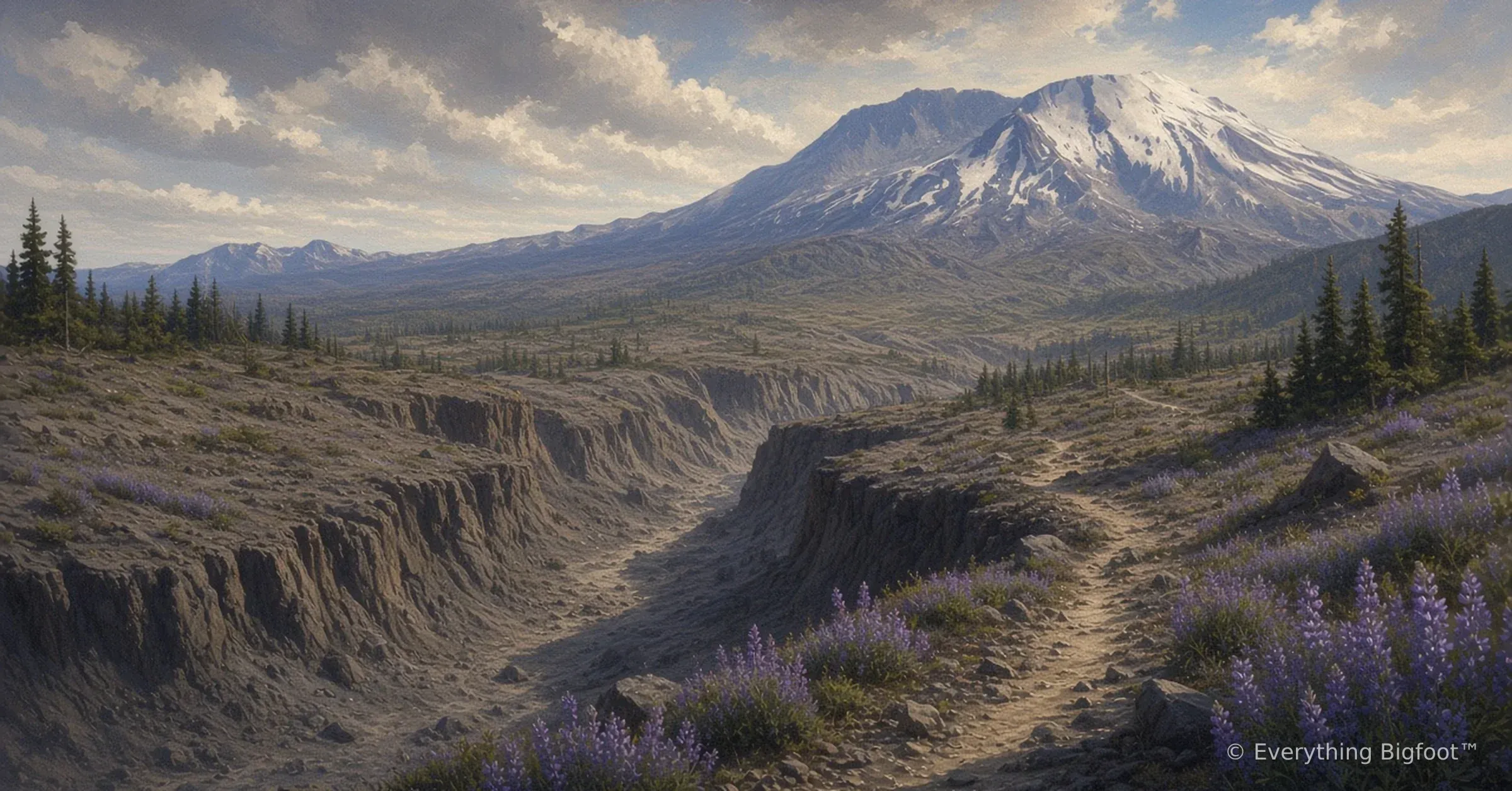
Long before anyone had heard the word "Bigfoot," a group of gold miners came down from Mount St. Helens with a story that made newspapers across the country. Their tale of giant hairy "apes" throwing rocks at their cabin in July 1924 gave a canyon its name, and it's still one of the most retold stories in Sasquatch history.
But as with many famous stories, the version people repeat today isn't quite what was reported at the time.
Where is Ape Canyon?
Ape Canyon is a real gorge on the southeast shoulder of Mount St. Helens, along the edge of the Plains of Abraham in Skamania County, Washington. At one point it narrows to just about eight feet across. The Washington Trails Association says the canyon is "named after a possible Sasquatch sighting in 1924."
(Don't confuse it with Ape Cave, a lava tube on the south side of the mountain. Different place, different story.)
Mount St. Helens itself is an active stratovolcano in the Cascade Volcanic Arc, about 52 miles northeast of Portland and 98 miles south of Seattle. Interestingly, the name "Ape Canyon" is younger than the story. According to IKnowBigfoot's review, it doesn't appear in the July 1924 newspaper accounts, which place the men in the Spirit Lake country north of the mountain. Beck himself wrote in 1967 that the canyon "was so named after an account of the incident reached the newspapers."
The mountain also had wild-man stories long before 1924. In 1847, the artist Paul Kane reported stories he'd heard from Native people about "skoocooms," described as a race of cannibalistic wild men living on the peak of Mount St. Helens. Later newspapers called the 1924 creatures "mountain devils," a term that echoed older local lore.
The story the miners told
Five prospectors were working a gold claim, called the Vander White, in the Spirit Lake country. The Seattle Star of July 14, 1924, named four: Marion and Roy Smith, J. Peterson and Fred Beck. The next day's Star quoted "Roy Smith, Fred Beck and Gabe Lefevre, three of the party of five prospectors," which is where the fifth name comes from. In his 1967 booklet, Beck named none of the others, saying he wanted "to avoid embarrassment to the relatives." In 2024, researcher Marc Myrsell told The Reflector that Roy Smith's full name was Leroy Perry Smith.
In outline, here's what the men said happened:
- For about a week, they heard whistling and thumping in the woods.
- Two of them saw a large, hairy, upright creature near a spring and shot at it.
- That night, creatures pelted the cabin with rocks and pushed at it until nearly dawn.
- In the morning, Beck said he shot one near the canyon rim and watched it fall in.
The men packed up and left. "We expected that people would disbelieve us," they told The Seattle Star, "but we ran into the beast ... four times, and finally packed up and left a perfectly good mine to get away from it."
How the newspapers told it
The first reports were dramatic. On July 14, 1924, The Seattle Star reported that the prospectors had been "held prisoner an entire night by a cordon of 30 gorillas" and that "more than 200 rocks crashed thru the roof." It called the whole thing an "intermittent three-day battle." The Alaska Daily Empire of July 15 described animals "with hairy bodies and faces, clawlike fingers, black hair and long arms," whose "footprints measured 14 inches."
Even the very first headline is a little uncertain. Daniel Perez's bibliography of the case lists a Longview Daily News item from July 12, "Kelso Miners Back With Tale Of 'Mountain Devils'," as the earliest dated entry. The famous Oregonian article is dated July 13 in Perez's list but July 16 in Wikipedia's Bigfoot article, and both can't be right.
Then the town of Kelso emptied into the hills. The Star reported an expedition led by Forest Ranger C. Parker, armed for big game and carrying cameras, and several more groups followed. Not everyone was impressed. Deputy game warden Justus Murk of Woodland, who'd spent twenty years in the Spirit Lake district, called the report "all bunk" and said he'd never seen signs of such animals.
What the investigators found
The results were thin. Returning visitors said the rocks were still inside the cabin, but no footprints were found nearby.
According to Wikipedia's summary, U.S. Forest Service rangers went into the "inaccessible canyon" and found nothing. They showed how 14-inch footprints could easily be faked and concluded the miners probably placed the rocks themselves. The Wikipedia article names those rangers as J.H. Huffman and William Welch. Within a week, newspapers were running headlines calling the story a myth. Perez's bibliography lists Oregonian headlines including "Tale Of Gorillas Branded As Myth" (July 18) and "Spirit Lake Cabin Harbors No Apes. Rocks Declared Taken From Diggings In Mine" (July 20).
There was another twist. Within days, some papers suggested the prospectors were spiritualists who'd held seances at the cabin. According to the Star of July 15, Beck denied those reports at the time.
Still, as Wikipedia puts it, "people still wanted to believe," and the story kept spreading.
Fred Beck's 1967 booklet
More than 40 years later, in 1967, Fred Beck told his version in a privately published booklet, *I Fought the Apemen of Mt. St. Helens*, written down by his son. It's the most-cited source on the case.
Interestingly, Beck's own account was tamer than the 1924 headlines in some ways. According to IKnowBigfoot's research:
- Beck wrote that he saw only three of the creatures together at one time, not 30.
- He said the rocks didn't break through the roof, though some fell down the chimney.
- He denied a popular claim that he was knocked out by a rock.
- He described one night of attacks, ending "just before daylight," not a three-day battle.
- He gave the largest track as 19 inches, bigger than the 14 inches in the 1924 papers.
But Beck's booklet is also stranger than most retellings admit. He described himself as clairvoyant, and he argued that the creatures were "not entirely of the world," more spiritual than physical. He even predicted, "No one will ever capture one, and no one will ever kill one." So the seance angle that Beck denied in 1924 became, by 1967, the heart of his book.
The 1982 confession
In 1982, a retired logger from Toledo, Washington, named Rant Mullins (his name is spelled several ways) said he'd carved wooden feet to make fake Bigfoot tracks for years. He was 86 at the time. Most of his story was about carving feet: he said that in 1930, while working for the Forest Service, he carved a pair of alder feet with a hatchet and a jackknife, and that a friend walked them around huckleberry pickers' cars at the base of Mount St. Helens. In a 1982 Skeptical Inquirer article, he was also quoted as saying that in 1924, he and a companion had rolled some rocks onto a cabin at Ape Canyon and "may have been responsible" for Beck's encounter.
That claim came 58 years after the fact, from one person, and even he hedged it. As IKnowBigfoot points out, rolled rocks might explain rocks, but not the daytime sighting, the shooting or the tracks. So the mystery, in a way, remains.
Why Ape Canyon still matters
Ape Canyon came 34 years before the word "Bigfoot" made headlines in 1958 (see Where the name Bigfoot came from). It's one of the earliest well-documented cases of the kind of story that would later become the Bigfoot legend.
It's also a perfect lesson in how stories grow. The first newspaper version was the wildest. The witness's own later account was different. And the "confession" that supposedly settled it was just one sentence about rocks.
Hiking Ape Canyon today
The May 18, 1980, eruption of Mount St. Helens, which began at 8:32 a.m. and is often considered the most disastrous volcanic event in US history, sent mudflows down the Muddy River, Pine Creek and Smith Creek, and Ape Canyon was heavily affected. Spirit Lake, once ringed with camps and lodges, was transformed. But you can still hike there. The Ape Canyon Trail (#234) is listed by the Washington Trails Association as:
- 11.0 miles round trip
- 1,400 feet of elevation gain
- High point of 4,200 feet
The trail climbs through one of the few remaining stretches of old-growth forest on Mount St. Helens, with Douglas, silver and noble firs, and it's popular with mountain bikers too. It's on the volcano's east side, in the Mount St. Helens National Volcanic Monument.
Tips:
- Go in summer or early fall. Snow can linger at higher elevations into early summer.
- Check road and trail conditions with the Gifford Pinchot National Forest before you go.
- Bring the Ten Essentials. See our gear checklist.
In 2024, the 100th anniversary of the story, The Reflector reported that researcher Marc Myrsell said he had located what he believes is the cabin's foundation in 2013, using a metal detector to find nails, a bucksaw, baling wire and old rifle casings. That's one researcher's report of his own fieldwork. It fits with Beck's 1967 note that the cabin stood for years and was visited by sightseers until it burned down.
The area is still part of Washington's Bigfoot story. Skamania County, home to Mount St. Helens and Ape Canyon, has 41 mapped reports in the public dataset we use for our sightings map, from 1950 to 2020, the third-most of any US county. Whether or not you believe in the "apemen," standing at the edge of Ape Canyon is a chance to stand inside one of Bigfoot's oldest stories.
Plan a whole trip around it with our Pacific Northwest Bigfoot road trip, and read more Washington history in Bigfoot in Washington State.