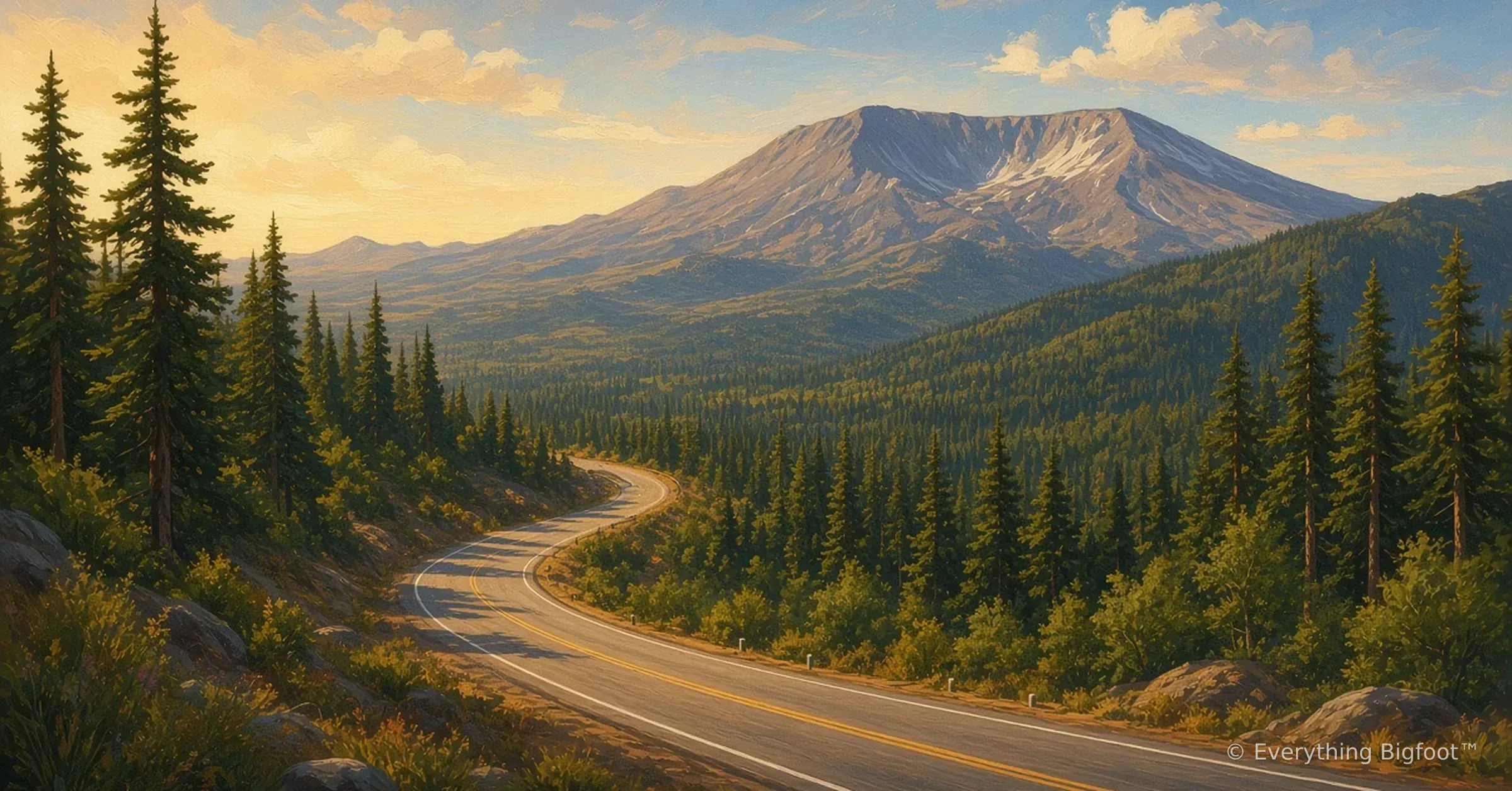
If Bigfoot has a home turf, it's the Pacific Northwest: deep evergreen forests, volcanoes, rivers and rain. Washington leads the nation in Bigfoot reports, Oregon and Northern California aren't far behind, and the whole region is packed with Bigfoot history.
This itinerary runs north to south, from Washington's Cascades to California's Bigfoot Capital of the World. Take it all at once over a week or more, or pick a section for a long weekend.
Before you go
- Road and trail conditions change. Mountain roads near Mount St. Helens and in the Klamath country can close for snow, washouts or wildfire. Check the Forest Service and state transportation sites before you go.
- Cell service is spotty. Download offline maps and carry a paper map.
- Pack the Ten Essentials for every hike. Our gear checklist has the full list.
- Fill up often. Gas stations are few and far between in the backcountry.
Stop 1: Mount St. Helens and Ape Canyon (Washington)
Start with one of the most famous stories in Bigfoot history. In the summer of 1924, a group of gold prospectors claimed they were attacked at night by 7-foot "apemen" who threw boulders at their cabin. The gorge on the east side of Mount St. Helens was later named Ape Canyon.
The canyon was heavily affected by the 1980 eruption. Today, the Ape Canyon trail runs alongside it and is popular with hikers and mountain bikers. Bonus: on the volcano's south side is Ape Cave, a lava tube with a related name.
The whole area is protected as Mount St. Helens National Volcanic Monument, 110,000 acres set aside by Congress on August 27, 1982, after the eruption. It's part of the Gifford Pinchot National Forest, and inside the monument the landscape is left to recover on its own, which makes it a fascinating place to see a forest coming back. The monument spans Cowlitz, Lewis and Skamania counties. Cowlitz County alone has 18 mapped reports in the public dataset, 11 of them Class A.
Full story in our upcoming post: Ape Canyon 1924.
Stop 2: Skamania County (Washington)
Mount St. Helens is mostly in Skamania County, home to one of the most famous Bigfoot laws ever written. On April 1, 1969, the county passed an ordinance making it illegal to kill a Sasquatch, with a penalty of up to $10,000 and five years in prison. In 1984, the county amended it, making the offense a misdemeanor and declaring the county a Sasquatch refuge.
Skamania County also had 41 mapped reports in the public BFRO dataset, third in Washington behind only Pierce and Snohomish counties, and third in the nation at the county level (mapped reports through 2021). That's remarkable for a county with just 12,036 residents at the 2020 census. Its reports run from 1950 to 2020, and 26 of the 41 are Class B (distant or poor-light views, plus all sound-only reports), which fits its steep, heavily forested terrain. The county seat is Stevenson, right on the river. See Bigfoot in Washington State for the full picture.
Fun side trip: the Columbia River Gorge runs along the county's southern edge. The canyon is up to 4,000 feet deep and stretches more than 80 miles through the Cascades, forming the Washington-Oregon line. It's the only navigable route through the range, so Washington State Route 14 on the north bank and Interstate 84 on the south bank both run through it, with waterfalls and viewpoints galore.
Stop 3: North American Bigfoot Center (Boring, Oregon)
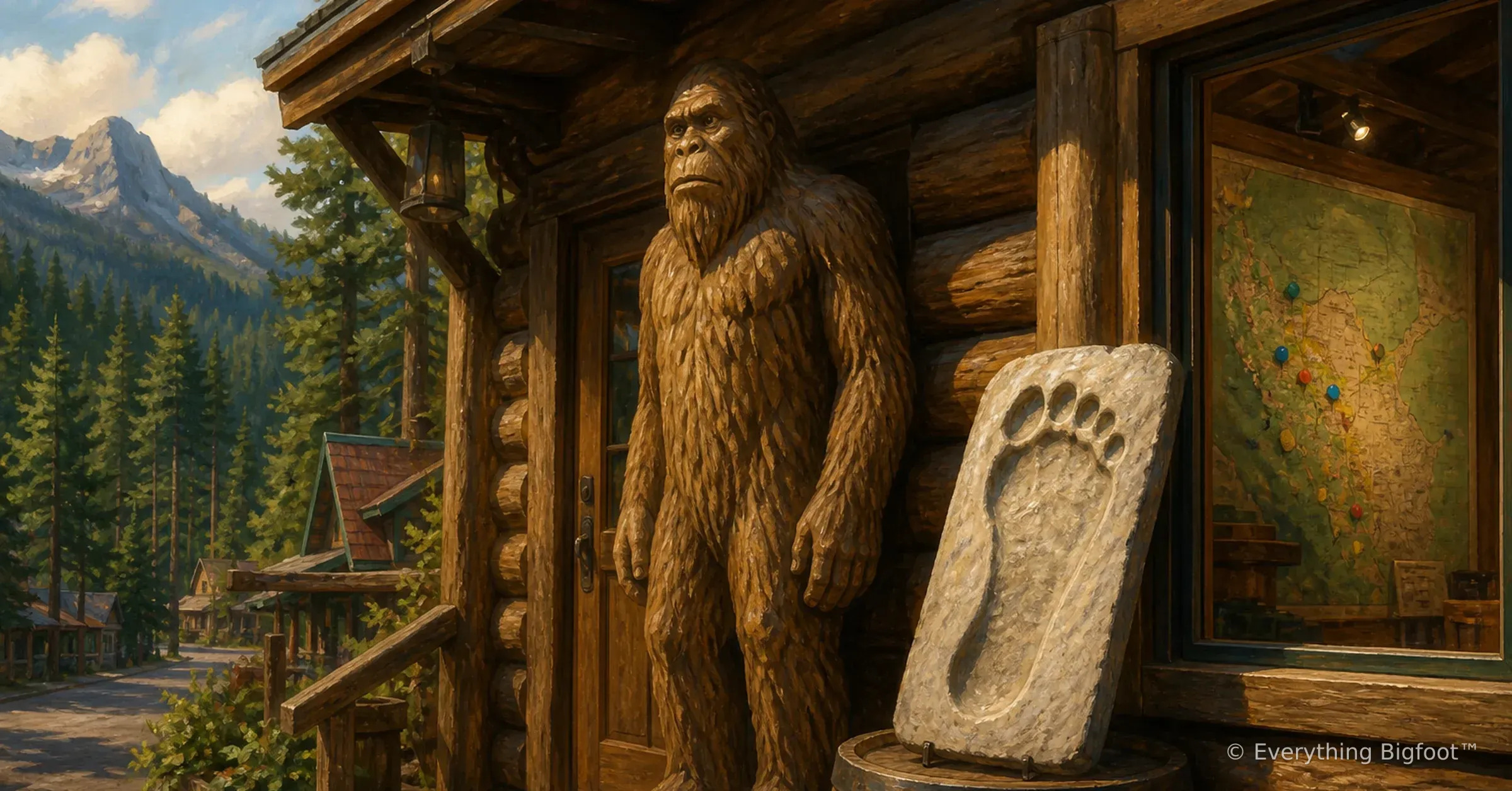
Cross the Columbia into Oregon and head east of Portland toward Mount Hood. At the junction of Highways 26 and 212 in Boring, you'll find the North American Bigfoot Center, opened in 2019 by Cliff Barackman of Finding Bigfoot. Expect casts, research exhibits and a big Bigfoot photo op.
- Address: 31297 SE Highway 26, Boring, OR
- Hours (per its website): open every day, 10 a.m. to 5 p.m.
Boring itself is a small unincorporated community in the Cascade foothills, about 12 miles southeast of downtown Portland. It's named for William Harrison Boring, a Union soldier and pioneer whose family farmed there starting in 1856. Yes, you can get a photo with a Bigfoot in a town called Boring.
From here you can continue up the Mount Hood corridor, where Clackamas County leads Oregon with 18 mapped reports in the public dataset (8 Class A, 10 Class B, from 1971 to 2013). The Mount Hood National Forest starts about 62 miles east of Portland and runs more than 60 miles south from the Columbia River Gorge to the lake basin of the Olallie Scenic Area, below Mount Jefferson.
Stop 4: Oregon's Cascades and forests
Heading south through Oregon, you'll pass through some of the state's top Bigfoot counties in the dataset, including Lane and Douglas (14 mapped reports each). The Willamette and Umpqua national forests have endless trails and campgrounds for a night of listening. More in our upcoming Bigfoot in Oregon.
Stop 5: The Bigfoot Trap (Rogue River–Siskiyou National Forest, Oregon)
Near the California line in southern Jackson County, about 3.1 miles from the border, you'll find one of the strangest Bigfoot landmarks anywhere: a 10-by-10-foot wooden box trap built in 1974 by the North American Wildlife Research Team. It sits along the Collings Mountain trail near Applegate Lake, a 988-acre reservoir about 27 miles southwest of Medford, reached by Applegate River Road, 16 miles south of Oregon Route 238.
The spot was picked because a local miner, Perry Lovell, said he'd found 18-inch, human-like tracks in his garden. The builders used 2x12 planks, heavy metal bands and telephone poles, with a metal door designed to slam shut when the bait was pulled.
The team kept it baited for six years and caught only bears. The Forest Service began restoring it in 2006, and the door is now bolted open, so go ahead and peek inside.
Stop 6: The Bigfoot Scenic Byway (California)
Cross into California and pick up State Route 96, the Bigfoot Scenic Byway. About 88 miles of the highway carry the designation as it follows the Klamath River through the Klamath and Six Rivers national forests. It's narrow, twisty and gorgeous. Take your time and use the pullouts.
Much of the drive runs through the Klamath National Forest, about 1.74 million acres of ponderosa and Jeffrey pine, Douglas fir and other conifers, including an estimated 168,000 acres of old growth. Ranger district offices in Happy Camp and Fort Jones are useful stops for maps and current conditions. Siskiyou County, which holds most of the forest, has 16 mapped reports in the public dataset, and 12 of them are Class A, one of the highest Class A shares of any Northern California county. Its earliest entry dates to 1944.
Stop 7: Willow Creek, Bigfoot Capital of the World (California)
End your trip in Willow Creek, a small town on the Trinity River in Humboldt County. Visit the Willow Creek–China Flat Museum at 38949 Highway 299 and its Bigfoot collection of casts, photos and Bluff Creek history. Check the hours before you go: per its website, it's open Wednesday through Sunday from May to September and Friday through Sunday in October, 10 a.m. to 4 p.m. Snap a photo with the town's Bigfoot art, and if your timing is right, catch Bigfoot Daze (check our festivals page for the date).
Willow Creek is about 50 miles south of the spot along Bluff Creek where the famous 1967 Patterson-Gimlin film was shot. Humboldt County has 19 mapped reports in the public dataset, running from 1957 all the way to 2021, so the stories here are still coming in. Read more in our Bigfoot in California guide.
Extend the trip
- North into Canada: Sasquatch Provincial Park, in the District of Kent in British Columbia, is named for the creature. The word "Sasquatch" is believed to be an anglicized form of sasq'ets, roughly "hairy man" in the Halq'emeylem language.
- More museums: see our full list of Bigfoot museums in the USA.
- Plan with data: zoom into any county on our sightings map to see where public reports cluster.
Road trip checklist
- [ ] Offline maps and a paper atlas
- [ ] Forest Service passes or parking permits where required
- [ ] Headlamp, layers and rain gear
- [ ] Camera, audio recorder and a notebook
- [ ] Snacks, water and a full tank
- [ ] A great Bigfoot playlist
Whether or not you spot anything big and hairy, this is one of the most beautiful drives in America. Happy squatching!