Washington may lead in sighting reports, but California has a strong claim to being Bigfoot's birthplace. It's where the name "Bigfoot" was born, where the most famous Bigfoot film was shot, and where a small mountain town calls itself the Bigfoot Capital of the World.
Where "Bigfoot" got its name
In 1958, bulldozer operator Jerry Crew found giant human-like footprints on a logging road in the Six Rivers National Forest in Humboldt County. His crew called the track-maker "Bigfoot." On October 6, 1958, the Humboldt Times ran a photo of Crew holding a plaster cast, and the name went national.
Decades later, after Ray Wallace died in 2002, his family revealed carved wooden feet and said he had made the tracks. The full story is in Where Did the Name Bigfoot Come From?
Bluff Creek and the 1967 film
On October 20, 1967, Roger Patterson and Bob Gimlin filmed a large, dark, upright figure walking along Bluff Creek in Northern California. The Patterson-Gimlin film is still the most debated piece of Bigfoot evidence ever recorded. Wikipedia places the film site beside a tributary of the Klamath River, about 25 logging-road miles northwest of Orleans, in Del Norte County on the Six Rivers National Forest. Patterson chose the area because of past reports and the giant footprints found there since 1958.
The story the two men told is full of small, checkable details. After filming, they tracked the figure until they lost it in heavy brush, then went back with plaster and cast the best right and left prints. That evening they met Al Hodgson at his variety store in Willow Creek, and Patterson called the Times-Standard in Eureka from the Lower Trinity Ranger Station. Overnight, heavy rain set in. For decades afterward the exact site was lost to regrowth after the 1964 flood, until researchers rediscovered it in 2011.
We go frame by frame through the history and the arguments in our upcoming Patterson-Gimlin film post.
Willow Creek: Bigfoot Capital of the World
Willow Creek is a small town on the Trinity River in Humboldt County, with a population of 1,720 in the 2020 census. According to Wikipedia, it sits about 50 miles south of where the Patterson-Gimlin film was made. Willow Creek calls itself the Bigfoot Capital of the World, and it's home to:
- The Willow Creek–China Flat Museum, with a large Bigfoot collection (thebigfootmuseum.com)
- Bigfoot Daze, a long-running annual festival with a parade. Historically it was held around Labor Day weekend, but recent editions have moved to late June, so check our festivals page for this year's date.
Fun fact: the town was originally called China Flat, after Chinese laborers from the mining and lumber camps. The post office changed its name to Willow Creek in 1915.
The Bigfoot Scenic Byway
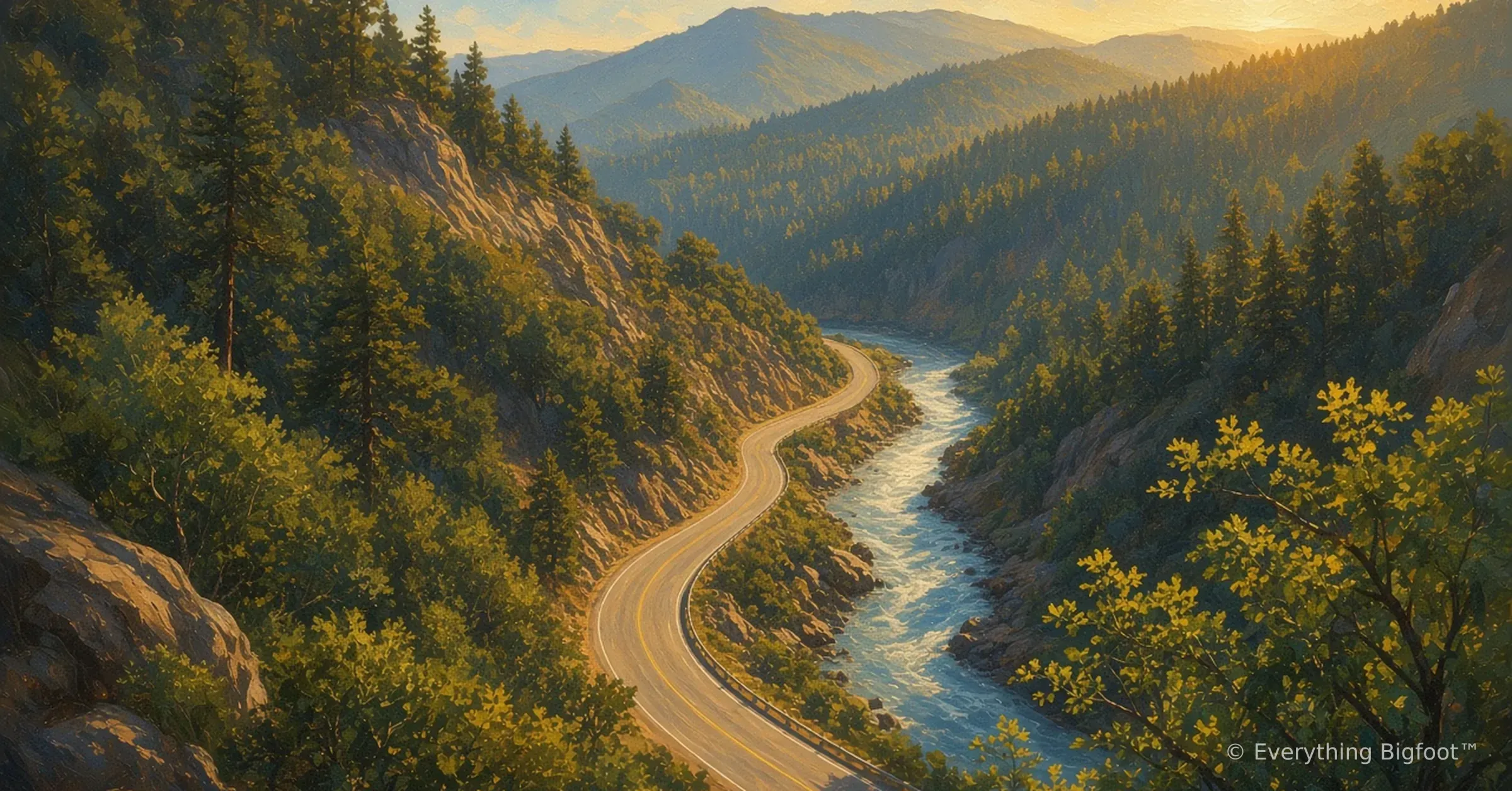
State Route 96, the Bigfoot Scenic Byway, runs about 88 miles through the Klamath River country of the Six Rivers and Klamath national forests. It's one of the most beautiful (and twisty) drives in the state, and a must for any Bigfoot road trip. Our upcoming Pacific Northwest road trip connects it with Oregon and Washington.
Older than Bigfoot: California's Indigenous traditions
California's hairy-giant stories go back much further than 1958.
- Painted Rock and the Hairy Man: On the Tule River Indian Reservation, Yokuts petroglyphs at a site called Painted Rock include a large figure called "Hairy Man" (also known as Mayak Datat). Author Kathy Moskowitz Strain, author of the 2008 book Giants, Cannibals, Monsters: Bigfoot in Native Culture, says the glyphs depict a group of Bigfoots called "the Family." They're estimated to be about 1,000 years old.
- Dark Watchers: Wikipedia notes that Spanish explorers and Mexican settlers told tales of the "Dark Watchers," large figures said to watch their camps at night.
Learn more in our post on Sasquatch and Native American legends.
California by the numbers
In the public BFRO dataset behind our sightings map, California has 277 mapped reports, fourth among all states. Its earliest entry, from 1869, is the oldest in the entire dataset.
| County | Mapped reports |
|---|---|
| Tuolumne | 36 |
| El Dorado | 22 |
| Humboldt | 19 |
| Shasta | 19 |
| Siskiyou | 16 |
| Tulare | 15 |
(Mapped reports in the public dataset through 2021, not total BFRO reports.)
Notice that the top two counties aren't on the North Coast at all. They're in the Sierra Nevada foothills, home to Yosemite's western gateway and Gold Country. Bigfoot reports in California run from the redwoods to the southern Sierra.
When California reports happen
- Summer is peak season. 123 of the 277 reports fall in June, July or August, compared with 88 in fall, 36 in spring and 30 in winter. August is the single busiest month with 51 reports, followed by July (45) and September (42).
- The 2000s dominate. 125 reports date to the 2000s, compared with 44 in the 1990s and 22 in the 2010s. Just 26 come from 2010 or later.
- Most are Class B. 172 reports are Class B (distant or poor-light views, plus all sound-only reports), 104 are Class A clear sightings and one is a secondhand Class C account.
Just past the top six, Mono County on the east side of the Sierra has 15 reports and Fresno County has 13. Those summer numbers track with when people are in the high country, from Yosemite's backcountry to the Klamath Mountains.
Will Bigfoot become California's state cryptid?
Not yet. In 2025, Assemblymember Chris Rogers introduced AB 666, a bill to name Bigfoot California's official state cryptid. According to the Legislature's bill-status page, it was held in committee and died on January 31, 2026. Maybe next session!
Other California Bigfoot stops
- Bigfoot Festival Green Valley Lake in the San Bernardino Mountains is a newer Southern California event; see our festival calendar.
- Bigfoot Discovery Museum in Felton (Santa Cruz Mountains) was a beloved stop for years, but listings say it's permanently closed.
Where to explore
California's busiest counties line up with some of the state's biggest national forests:
- Stanislaus National Forest (Tuolumne County): 898,099 acres of the Sierra Nevada across four counties. Established in 1897, it's one of the oldest national forests in the country, and Tuolumne County leads the state in mapped reports.
- Eldorado National Forest (El Dorado County): the central Sierra, east of Sacramento, in the No. 2 county on our list.
- Six Rivers National Forest (Humboldt and Del Norte counties): the northwestern corner of the state, home to Bluff Creek and the 1958 tracks.
- Shasta–Trinity National Forest (Shasta and Trinity counties): California's largest national forest at 3,454 square miles, with five wilderness areas, Shasta Lake and 14,179-foot Mount Shasta.
- Klamath National Forest (Siskiyou County): 1,737,774 acres in the Klamath Mountains and the Cascades, with an estimated 168,000 acres of old-growth forest. Forest headquarters are in Yreka, with ranger district offices in Fort Jones, Happy Camp and Macdoel.
Plan your visit
Northern California's Bigfoot country is remote and rugged. Roads are narrow and winding, cell service is spotty, and summer wildfire season can close routes. Check Caltrans and Forest Service conditions before you go, carry the Ten Essentials (see our gear checklist), and fill your tank whenever you can.
For more stops, see our upcoming guide to Bigfoot museums in the USA.