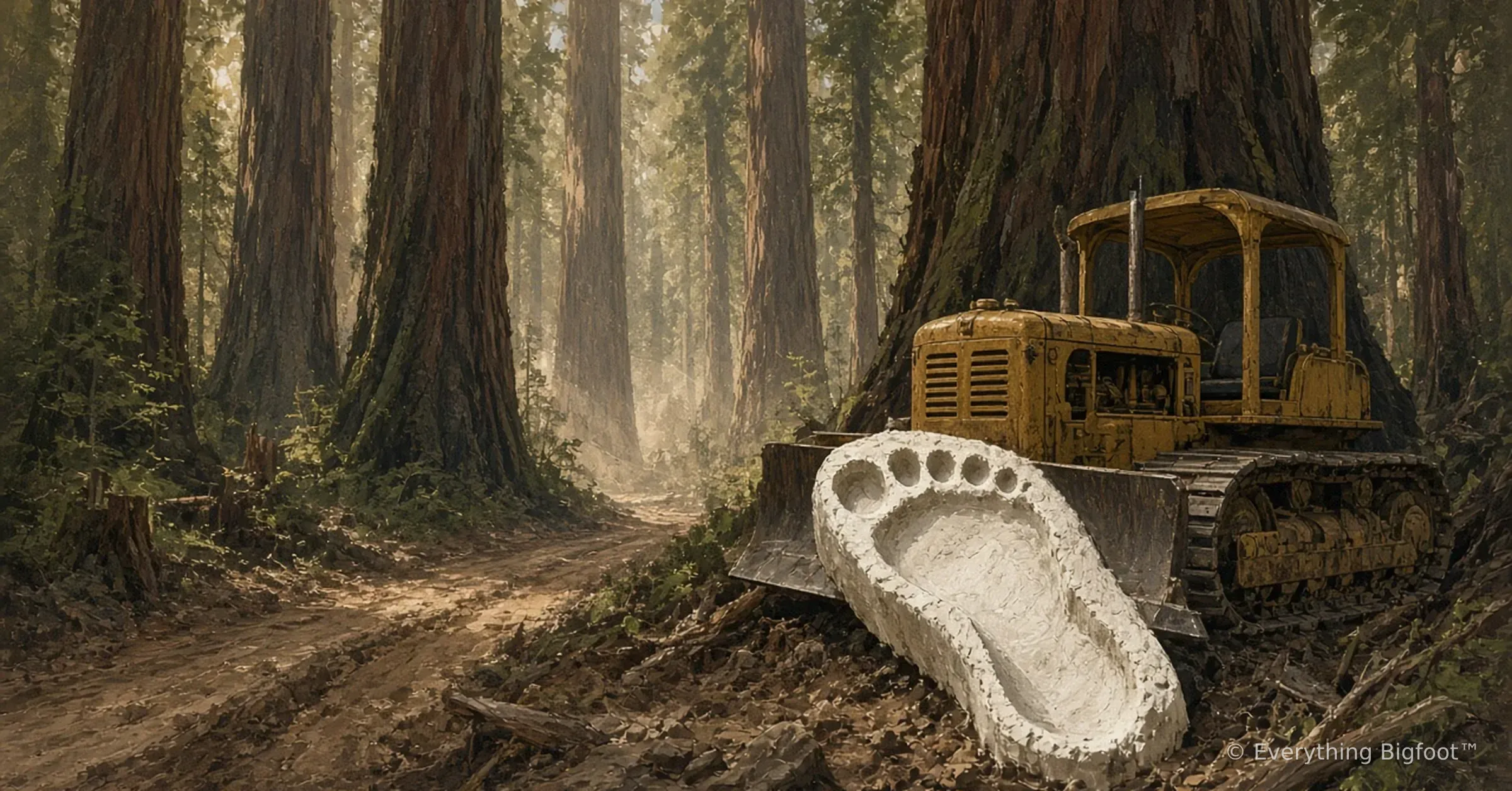
Every legend needs a name. For America's most famous one, the name came from a muddy logging road, a bulldozer, and a reporter who knew a good story when he saw one.
A logging road in Humboldt County
In 1958, Jerry Crew was running a bulldozer for a logging company working in the Six Rivers National Forest in Humboldt County, California. This was rugged country near Bluff Creek, a tributary in the Klamath River system that would later become the most famous creek in Bigfoot history.
One day Crew found something in the mud: a set of huge, human-like footprints, about 16 inches long, pressed deep into the ground.
When he told his coworkers, it turned out he wasn't the only one who'd seen them. Several men said they'd noticed similar tracks at earlier job sites. They also told stories about strange things around the camp, including a 450-pound oil drum that had supposedly been moved without explanation. The crew started calling whatever was making the tracks "Bigfoot." Crew's employer was a road construction company owned by a logger named Ray Wallace, a name that comes back later in this story.
At first Crew and the others thought someone was pulling a prank. But the tracks kept showing up.
The plaster cast heard 'round the country
Crew made a plaster cast of one of the footprints and reached out to Andrew Genzoli, a reporter at the Humboldt Times. Genzoli interviewed the loggers and wrote up the story, using the crew's nickname: Bigfoot.
On October 6, 1958, the Humboldt Times ran a front-page photo of Jerry Crew holding that enormous plaster cast. The timing was perfect. The story spread fast, and Genzoli soon heard from major outlets, including the New York Times and the Los Angeles Times. Within a short time, "Bigfoot" had become the go-to word for a big, unknown creature leaving giant footprints in Northern California.
There's a small wrinkle in the dates. Wikipedia's article on Ray Wallace says the Humboldt Times of Eureka first used the word "Bigfoot" in a story in August 1958, while the famous front-page photo of Crew and his cast ran on October 6. Either way, the word went from a logging crew's joke to a national headline in a matter of weeks.
Wait, wasn't "Sasquatch" already a word?
It was. The word Sasquatch had been in print since 1929, when J.W. Burns published stories of British Columbia's "hairy giants" in Maclean's. Burns was an Indian agent and teacher who lived and worked with the Sts'ailes Nation (then called the Chehalis First Nation). The word he coined is believed to be an anglicized version of sasq'ets, roughly "hairy man" in the Halq'emeylem language. Burns described the Sasquatch as "a tribe of hairy people whom they claim have always lived in the mountains, in tunnels and caves." According to Merriam-Webster, as summarized on Wikipedia, "Sasquatch" is a synonym for Bigfoot in English and predates it by roughly fifty years. (We cover that in Bigfoot vs Sasquatch vs Yeti.)
But in the United States, "Bigfoot" was catchy, easy to say, and tied to a dramatic newspaper photo. It took over, and it's still the most common name for the creature in the US.
"Big Foot" before Bigfoot
The phrase "big foot" didn't come out of nowhere. Wikipedia lists several earlier uses:
- In the 1830s, a Wyandot chief was nicknamed "Big Foot" because of his size, strength and large feet.
- Potawatomi Chief Big Foot is closely associated with Walworth County, Wisconsin, where a state park bears his name.
- Texas Ranger William A. A. Wallace was nicknamed "Bigfoot" for his large feet. The town of Bigfoot, Texas is named for him.
- Lakota leader Spotted Elk was also called "Chief Big Foot."
- In the late 1800s and early 1900s, at least two huge grizzly bears were nicknamed "Bigfoot" in the newspapers. The first was reportedly killed near Fresno, California, in 1895 after killing sheep for 15 years; its weight was estimated at 2,000 pounds. The second roamed Idaho between the Snake and Salmon rivers in the 1890s and 1900s, and people credited it with supernatural powers.
None of those were the hairy forest giant we think of today, but the nickname was clearly floating around in American culture long before 1958.
The twist: Ray Wallace and the wooden feet
Here's where the story gets complicated. Ray Wallace was born in Clarksdale, Missouri, in 1918, served as an aircraft gunner in World War II and spent much of his life logging and building roads in Washington, Oregon and California before settling in Toledo, Washington, in 1961. He died in a Centralia, Washington, nursing home on November 26, 2002, at age 84.
After his death, Wallace's family revealed a collection of large carved wooden feet kept in his basement. They said Wallace had secretly made the footprints, including the tracks Crew found. It was his son Michael who made the reveal, and Wikipedia describes the feet as large and poorly crafted. The family said Ray's brother Wilbur and nephew Mack McKinley used them to stamp prints around Northern California as a prank. The family also said Wallace made hair samples from the bison on his animal farm near Toledo, and fake droppings, and left them in the woods for researchers to find.
According to Wikipedia's summary, Wallace was inspired by another hoaxer, Rant Mullens. In the 1930s, Mullens and other foresters around Toledo, Washington carved big wooden feet and used them to make tracks that would startle huckleberry pickers. Mullens went public about his hoaxes in 1982. He and his fellow foresters called themselves the "St. Helens Apes" and even claimed responsibility for the 1924 Ape Canyon incident (more in our upcoming Ape Canyon post). Wallace, also from Toledo, said he got a pair of wooden feet through Mullens and used them on the 1958 construction site to scare off potential thieves.
Not everyone accepts the family's account. Researcher Chris Murphy noted that Ed Schillinger, described as the only living witness from the Bluff Creek job and someone who considered himself almost an adopted son of Wallace, strongly disputed it. At the same time, some cryptozoologists had doubted Crew's tracks all along: Mark A. Hall was a persistent critic of the 1958 tracks and some other Bluff Creek prints, and Loren Coleman was similarly critical. Wallace also claimed he told Roger Patterson where to go to film in 1967, but anthropologist Jeff Meldrum wrote that later interviews showed Wallace "possessed little knowledge of the specific area."
Does that settle everything? For many people, it explains the 1958 tracks. Plenty of Bigfoot enthusiasts point out that it doesn't explain every report before or since. Either way, the 1958 episode is a great example of how a single story, a single photo and a single catchy word can shape a legend for generations.
Why it still matters
The 1958 tracks put the Bluff Creek area on the map for Bigfoot fans. Less than ten years later, in October 1967, Roger Patterson and Bob Gimlin shot their famous film along Bluff Creek. We dig into that in our upcoming post on the Patterson-Gimlin film.
Today you can drive the Bigfoot Scenic Byway, about 88 miles of California State Route 96, and stop in Willow Creek. The roadhead of the Bluff Creek / Fish Lake Road, near which many of the reported sightings and footprint finds occurred, is about 50 miles north of town along Route 96. The town calls itself the Bigfoot Capital of the World and has a Bigfoot museum and the long-running Bigfoot Daze festival. Our upcoming Bigfoot in California post covers the whole region.
Quick recap
- 1958: Jerry Crew finds 16-inch tracks in Humboldt County's Six Rivers National Forest.
- The logging crew nicknames the track-maker "Bigfoot."
- October 6, 1958: the Humboldt Times runs Crew's photo with a plaster cast, and the name goes national.
- 2002: Ray Wallace's family reveals carved wooden feet and says he made the tracks.
Pretty remarkable that a muddy logging road gave us one of the most famous words in American folklore. Next time you're wearing a Everything Bigfoot™ shirt, you can tell people exactly where the name came from.