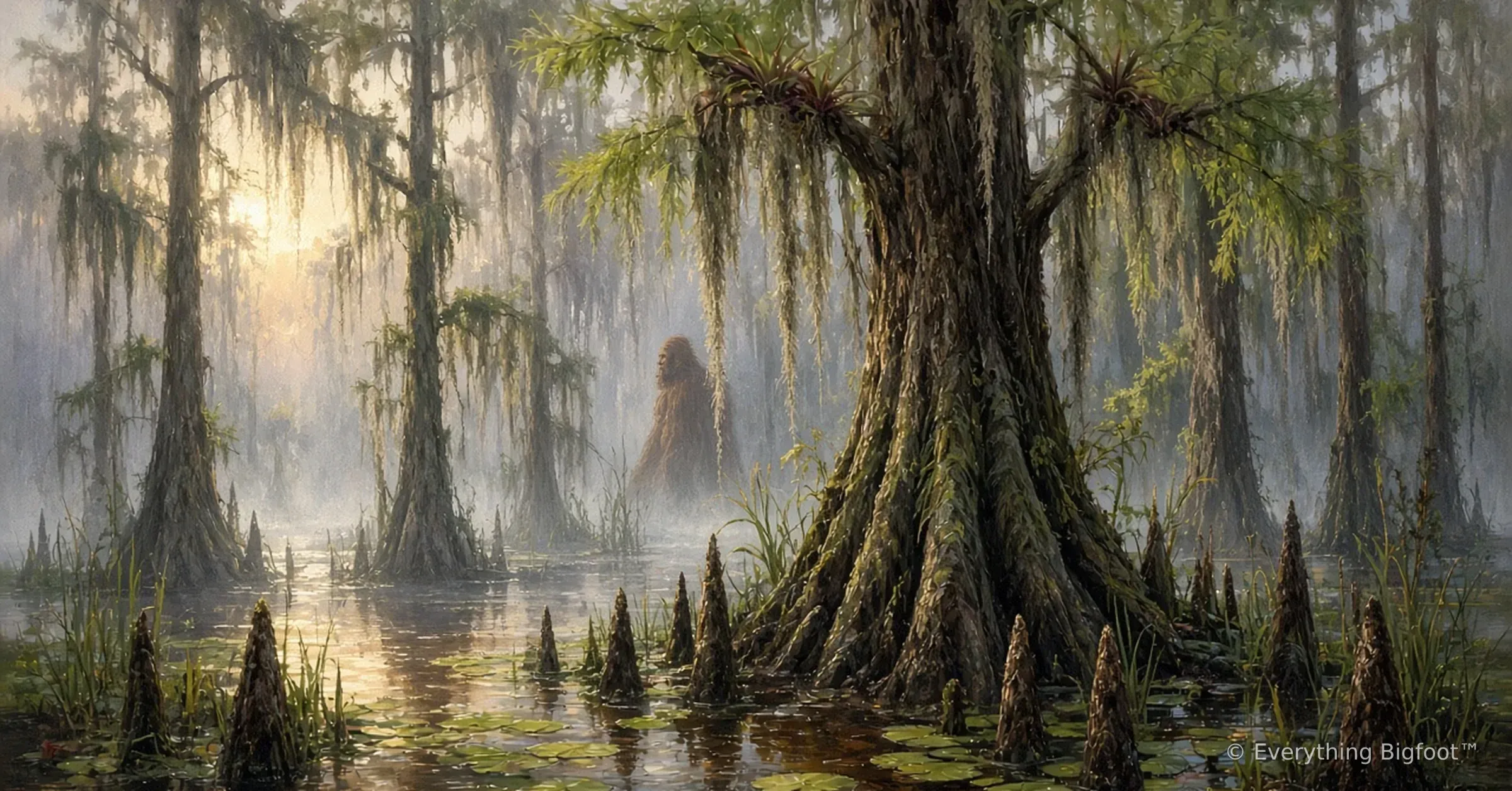
Every region has its own version of Bigfoot. Florida's might be the most memorable, because you're supposed to smell it before you see it.
Meet the Skunk Ape: the swamp-dwelling, reddish-haired, famously stinky cousin of Bigfoot. It's said to roam the Everglades, Big Cypress and woods all over the Sunshine State.
What is the Skunk Ape?
Wikipedia describes the Skunk Ape as a large, hairy, human- or ape-like creature said to live in the forests and swamps of the southeastern United States, especially Florida. Typical descriptions include:
- Height: about 5 to 7 feet. That's often smaller than the classic Pacific Northwest Bigfoot.
- Hair: mottled, reddish-brown
- Walk: upright, on two legs
- Smell: strong and foul, often compared to a skunk. That's where the name comes from.
The Skunk Ape is often called Bigfoot's "cousin." Some folks treat it as simply Florida's name for Bigfoot. Either way, it's become a real part of Southern pop culture, especially in Florida, where you'll find it on bumper stickers, T-shirts, and roadside signs. Wikipedia calls it an unofficial mascot of Florida's wilderness and rural culture, and when the COVID-19 pandemic began, Orlando's Gatorland used the Skunk Ape's famous smell to promote social distancing.
A history that goes back to 1818
Stories of hairy wild men in the Southeast go back a long way. According to Wikipedia, in 1818 local newspapers reported a story from what is now Apalachicola, Florida, about a "man-sized monkey" raiding food stores and stalking fishermen along the shore.
You'll sometimes read that Seminole and Miccosukee traditions include a creature called Esti Capcaki, meaning roughly "hairy giant." Wikipedia notes that these claims, made by cryptozoologists, are unsubstantiated, so we're careful not to present them as established tribal tradition.
Famous Skunk Ape stories
Here are some of the best-known reports, as summarized on Wikipedia.
1929: the Perky Bat Tower. In the Florida Keys, a tower was built to house bats that would eat mosquitoes. According to the story, an ape-like creature was drawn to the construction site, shook the tower and scared off the bats.
1940s: the Bardin Booger. In the small community of Bardin in Putnam County, a string of sightings starting in the 1940s gave Florida one of its best local nicknames.
1942: Suwannee County. A driver on an isolated road said a similar creature rushed out of the brush, grabbed his vehicle and beat on the running board and door for half a mile before letting go.
1960s: Alachua and Marion counties. A rash of sightings hit central Florida. In one 1963 report, several members of a family said an ape-like creature came around their rural home, once approaching a window at night to peer inside.
1970s: Palm Beach County deputies. Two sheriff's deputies, Marvin Lewis and Ernie Milner, said an ape-like creature stalked them through a grove before they fired at it. They said they followed a trail of footprints and recovered hair snagged on a pushed-down barbed-wire fence.
1971–1975: Broward County. This rash of sightings did a lot to popularize the term "Skunk Ape." Newspapers in Broward County and as far away as Miami covered witnesses describing a 5 to 7 foot creature with dark red to black fur. Reports claimed the creature had invaded homes, stalked people and killed a farmer's livestock, including a horse and a bull. Police investigated after an officer reported hitting it with his car. Posses went out looking. No body or hard evidence was ever found.
1977: the Florida bill. A bill was proposed in the Florida legislature to make it illegal to "take, possess, harm or molest anthropoids or humanoid animals." It did not pass, but it's a fun piece of Skunk Ape trivia.
1997: the Everglades. That July, Everglades tour operator David Shealy reported that bait stands laden with lima beans had been raided and strange tracks left behind. He baited more spots with lima beans, and several witnesses reported sightings soon after. Shealy and others blamed high seasonal flooding, which they said had pushed animals onto smaller patches of high ground. Tour operators Steve Goodbread and Dow Rowland also reported a sighting, as did some of their guests, and they argued that 100°F heat, high humidity and the remote location made a hoax unlikely. The same year, Ochopee Fire Control District Chief Vince Doerr took a photo of a dark, upright figure he said crossed the road. Within two weeks, more than fifty people reported sightings in the Big Cypress National Preserve area.
2000: the Sarasota photos. The Sarasota County Sheriff's Office received two anonymous photos of a large, hairy, ape-like figure. The letter writer said it had been stealing apples from her porch near I-75. The writer said she was an elderly woman who feared the animal was an escaped orangutan that might harm her family. These are often called the "Myakka photos," after the Myakka River area east of I-75 in Sarasota County, home of one of Florida's largest state parks (37,000 acres).
How many Florida reports are there?
Wikipedia notes that the BFRO has archived hundreds of alleged sightings from almost every county in Florida. In the public BFRO dataset we use for our sightings map, Florida has 281 mapped reports. That's third in the nation, behind only Washington and Ohio. The earliest Florida entry in that set is from 1947, in Putnam County, the home of the Bardin Booger. Wikipedia adds that 48 of Florida's 67 counties have reported sightings since 2010.
Here's what else the dataset shows (mapped reports through 2021):
- Top counties: Collier (20), Marion (18), Lake (17) and Clay (16). In total, 58 Florida counties have at least one mapped report.
- Class mix: 144 Class A (clear sightings) and 137 Class B (distant or poor-light views, plus all sound-only reports), close to the national even split.
- A fall and winter state: Florida's busiest months are November (33) and October (31), and about 21% of its reports come in winter, compared with about 16% nationally. April is its quietest month, with 13.
- Peak decade: the 2000s, with 100 reports. Florida's 78 reports since 2010 rank third in the nation for that period, behind Washington (120) and Illinois (91).
Collier County: Skunk Ape central
It's fitting that Collier County tops the Florida list. It's home to Ochopee, the Tamiami Trail (the southernmost 284 miles of U.S. 41) and much of Big Cypress National Preserve. Its 20 mapped reports run from 1975 to 2012: 9 Class A and 11 Class B, including footprints found while hunting, unusual sounds near the water and several sightings of a large upright figure along roads. One Class A report is dated July 1997, the same summer as the Shealy and Doerr reports.
See how Florida stacks up in our Bigfoot sightings by state breakdown.
What do scientists say?
Most mainstream scientists don't accept the Skunk Ape as a real animal. They point to a combination of folklore, mistaken identity, and hoaxes. Skeptical investigator Joe Nickell has suggested that some reports may be Florida black bears, possibly ones suffering from mange, with others being hoaxes or misidentified wildlife. Wikipedia also notes that the National Park Service considers the Skunk Ape a hoax. And the swamp is very good at making ordinary sounds and shapes feel spooky.
That doesn't make the stories any less fun. The Skunk Ape is a great example of how a legend adapts to its home: shorter and redder than its northern cousin, at home in the heat and humidity, and famous above all for its smell.
Want to go looking?
If you head into Skunk Ape country, keep it safe and respectful:
- Big Cypress National Preserve covers 720,000 acres about 45 miles west of Miami. Along with Big Thicket in Texas, it became one of the first two national preserves in the National Park System on October 11, 1974. It's managed by the National Park Service. Check nps.gov/bicy for current conditions, rules and alerts before you go.
- Respect the wildlife. Florida swamps are home to alligators, snakes and protected species. Keep your distance and never feed animals.
- Bring water, bug spray, and sun protection. The heat is no joke, especially in summer.
- Leave No Trace. Pack out everything you bring in.
For the full roadside experience, the Skunk Ape Research Headquarters sits on the Trail Lakes Campground property at 40904 Tamiami Trail East in Ochopee. Its website lists tours, an animal exhibit and camping, and the gift shop sells a signed Everglades Skunk Ape Research Field Guide and a tongue-in-cheek "Skunkape Permit" sticker. It's 15 miles south of I-75, four miles east of Highway 29, about 36 miles from Naples and 60 from Miami. We'll round up more stops like it in an upcoming guide to Bigfoot museums in the USA.
Other swamp cousins
The Southeast is full of hairy swamp legends. Louisiana has the Honey Island Swamp Monster, and Arkansas has the Fouke Monster of Boggy Creek. Check out our guide to Bigfoot names by state to find your local legend. Our post on the Honey Island Swamp Monster is coming later this spring.
And if a Florida Bigfoot gathering sounds like your idea of fun, keep an eye on our festivals page. The Great Florida Bigfoot Conference in Ocala is listed for June.
Just maybe bring a clothespin for your nose.