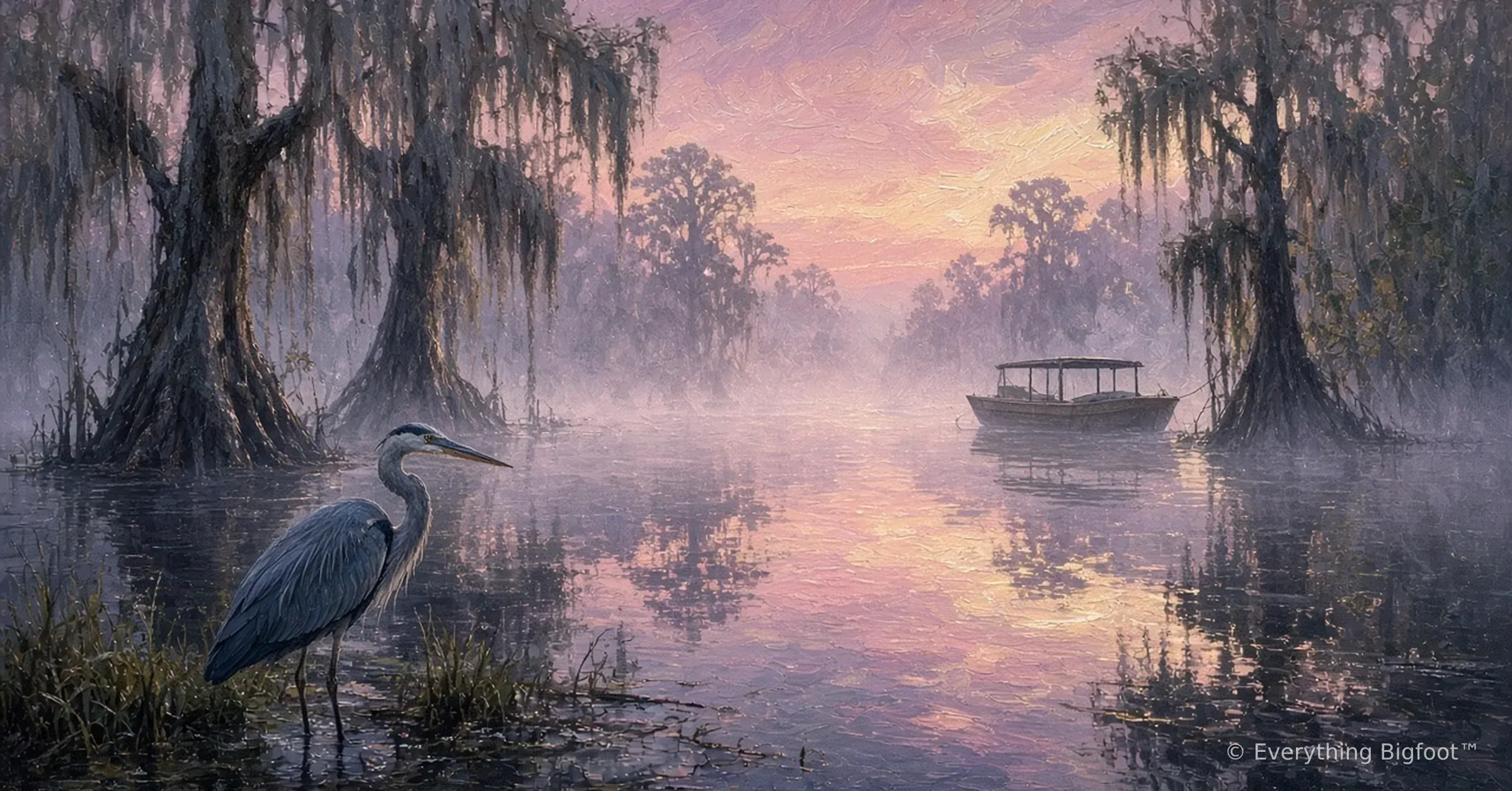
Florida has its Skunk Ape. Arkansas has the Fouke Monster. And down in southeast Louisiana, in the cypress swamps along the Pearl River, there's the Honey Island Swamp Monster, the bayou's own version of Bigfoot.
Where is Honey Island Swamp?
Honey Island Swamp is in St. Tammany Parish, Louisiana, in the bottomlands and bayous along the Pearl River, which forms part of the border with Mississippi. It's thick, wet, beautiful country, full of cypress, tupelo, alligators and birds. It's also one of the region's most popular places for swamp tours, and according to Wikipedia, many local tour companies make good use of the legend.
A few facts to get your bearings:
- The name: Honey Island got its name from the honey bees once seen in abundance on a nearby isle.
- The boundaries: the swamp is bordered by U.S. 11 to the north, Lake Borgne to the south, the Pearl River to the east and the West Pearl River to the west. Wikipedia describes it as more than 20 miles long and nearly 7 miles across.
- The protected land: much of it lies inside the Pearl River Wildlife Management Area, a 35,619-acre tract near Slidell managed by the Louisiana Department of Wildlife and Fisheries. Upriver, the Bogue Chitto National Wildlife Refuge protects another 36,000 acres of Pearl River Basin swampland about 60 miles northeast of New Orleans.
- The river: the Pearl is a blackwater river that rises in Neshoba County, Mississippi, and has a meander length of 444 miles. Its lower stretch forms part of the Mississippi-Louisiana line.
- The parish: St. Tammany Parish, founded in 1810, is named for Tamanend, the Lenape "Chief of Chiefs." With 264,570 people at the 2020 census, it's Louisiana's fourth-most populous parish. Slidell (28,781 people), on the northeast shore of Lake Pontchartrain, is the nearest city to the swamp and part of the New Orleans metro area.
Who else lives in the swamp?
You don't need a monster to make Honey Island feel wild. Wikipedia's list of native animals includes the American alligator, alligator snapping turtle, western cottonmouth, coypu (nutria), red fox, Louisiana black bear, bobcat, raccoon, mink, barred owl, bald eagle, great blue heron, alligator gar and paddlefish. A black bear standing up in the brush, a barred owl calling after dark or a big gator sliding off a log could all give a nervous visitor a jolt.
What does it look like?
According to the stories, the Honey Island Swamp Monster is:
- About 7 feet tall and walks upright on two legs
- Covered in gray hair (not the usual brown or black)
- Known for yellow or red eyes
- Known for a terrible smell
The strangest detail is its feet. Plaster casts said to come from the creature show four toes, which doesn't match any known primate. That's one reason the Honey Island legend is sometimes considered its own creature rather than just a Southern Bigfoot.
The Harlan Ford story
The legend as we know it starts with Harlan Ford, a retired air traffic controller who had taken up wildlife photography. According to Wikipedia, Ford reported the first sighting in 1963.
In 1974, Ford and his friend Billy Mills said they found unusual footprints in the swamp, along with the body of a wild boar whose throat had been gashed.
Ford died in 1980. Afterward, a reel of Super 8 film said to show the creature was found among his belongings. That footage has turned up in TV specials ever since.
A circus train origin story?
Local lore offers a colorful explanation: in the early 20th century, the story goes, a train carrying a traveling circus crashed near the swamp, and its chimpanzees escaped and adapted to life in the bayou. There's no documented evidence for this, but it's a great campfire tale.
The skeptics' view
Scientists who know the swamp well have been skeptical. Wikipedia notes that ecologist Paul Wagner, who ran swamp tours in the area with his wife Sue and their guide Robbie Charbonnet, said none of them found evidence of the creature. Skeptic Joe Nickell described them as "ambivalent" about its existence.
TV investigators have weighed in too:
- On Fact or Faked: Paranormal Files ("Bayou Beast/River Ghost"), investigators recreated something similar to Ford's footage using a person in a ghillie suit, a camouflage outfit used by hunters. They concluded the film could be a case of mistaken identity but didn't rule out a creature.
- On America Unearthed ("Bigfoot in the Bayou," 2019), presenter Scott Wolter suggested the bad smell was most likely methane from decaying plants.
Honey Island on screen
The monster is a TV regular. According to Wikipedia it has appeared on:
- In Search of... ("The Swamp Monster")
- Lost Tapes ("Swamp Creature")
- Swamp People ("Full Moon Fever"), with Harlan Ford's granddaughter joining a search
- Monsters and Mysteries in America ("The Swamp")
- Mysteries at the Museum (2012)
- The Secret Saturdays animated series
It even inspired a Monster High doll character, "Honey Swamp," introduced by Mattel as the monster's daughter at San Diego Comic-Con on July 20, 2013. A few more appearances worth knowing:
- In The Secret Saturdays episode "Ghost in the Machine," the monster had crab-like claws and crocodilian feet, with vocal effects by Dee Bradley Baker.
- Author Eoin Colfer drew on the legend for the character Vern in his novel Highfire.
- A version of the creature appears in the role-playing supplement GURPS Monsters.
- In the 2025 video game South of Midnight, "Honey" is reimagined as a gentle golem of leaves, vines and branches with a tragic backstory, which is a long way from Harlan Ford's gray-haired swamp ape.
Bigfoot in Louisiana: the numbers
Louisiana is a smaller player in the BFRO data. The public dataset behind our sightings map has 33 mapped reports for the state. The top parish is Rapides (6) in central Louisiana, followed by Webster and Grant (3 each). The earliest Louisiana entry dates to 1925 (mapped reports in the public dataset through 2021).
Looking closer at the 33 reports (mapped reports in the public dataset through 2021):
- Class: 24 are Class A (clear sightings) and 9 are Class B (distant or poor-light views, plus all sound-only reports). That's a much higher Class A share than the national split, which is almost exactly even, but 33 reports is a small sample.
- Rapides Parish: all six reports are Class A sightings of a large upright figure, dated 1977, 1978, 1980, 1981, 1985 and 2000, and every one with a listed season falls in summer or fall.
- The oldest: the 1925 entry is a Class B report from Avoyelles Parish of a possible encounter without a clear view.
- Seasons: summer leads with 13, then fall with 10, winter with 6 and spring with 4. July (7) and June (5) are the busiest months.
- Decades: the 1970s (9) and 1980s (8) were Louisiana's peak; only 4 reports date from 2010 or later.
- Closest to the swamp: the nearest mapped report is a 1991 Class B report of unusual sounds heard while hunting in Washington Parish, St. Tammany's northern neighbor. St. Tammany Parish itself has no mapped reports.
Note that most of these reports come from central and northern Louisiana, closer to the piney woods of East Texas and the Arkansas line than to Honey Island. It's a reminder that the "Southern Bigfoot" belt stretches from the Gulf swamps to the Ozarks.
How does it compare to other Southern cryptids?
| Creature | State | Famous trait |
|---|---|---|
| Honey Island Swamp Monster | Louisiana | Gray hair, four-toed tracks |
| Skunk Ape | Florida | Overpowering stink |
| Fouke Monster | Arkansas | The Legend of Boggy Creek |
All three share swampy or bottomland habitat, a bad smell and roots in local storytelling. For more regional names, see our Bigfoot names by state guide.
Visiting Honey Island Swamp
The easiest way to see the swamp is on a guided boat tour. Several operators work the area northeast of New Orleans, and guides are usually happy to share the legend (even if they've never seen the monster themselves).
Tips:
- Go early or late in the day for cooler temperatures and more wildlife.
- Bring bug spray, sunscreen and water. Louisiana summers are hot and humid.
- Respect the wildlife. Alligators are real, even if the monster isn't proven! Keep hands inside the boat and never feed wildlife.
- Stay on established routes. The swamp's channels are easy to get lost in.
Whether you're hoping for a glimpse of gray fur in the cypress or just want to see one of the South's wildest places, Honey Island Swamp is worth the trip.