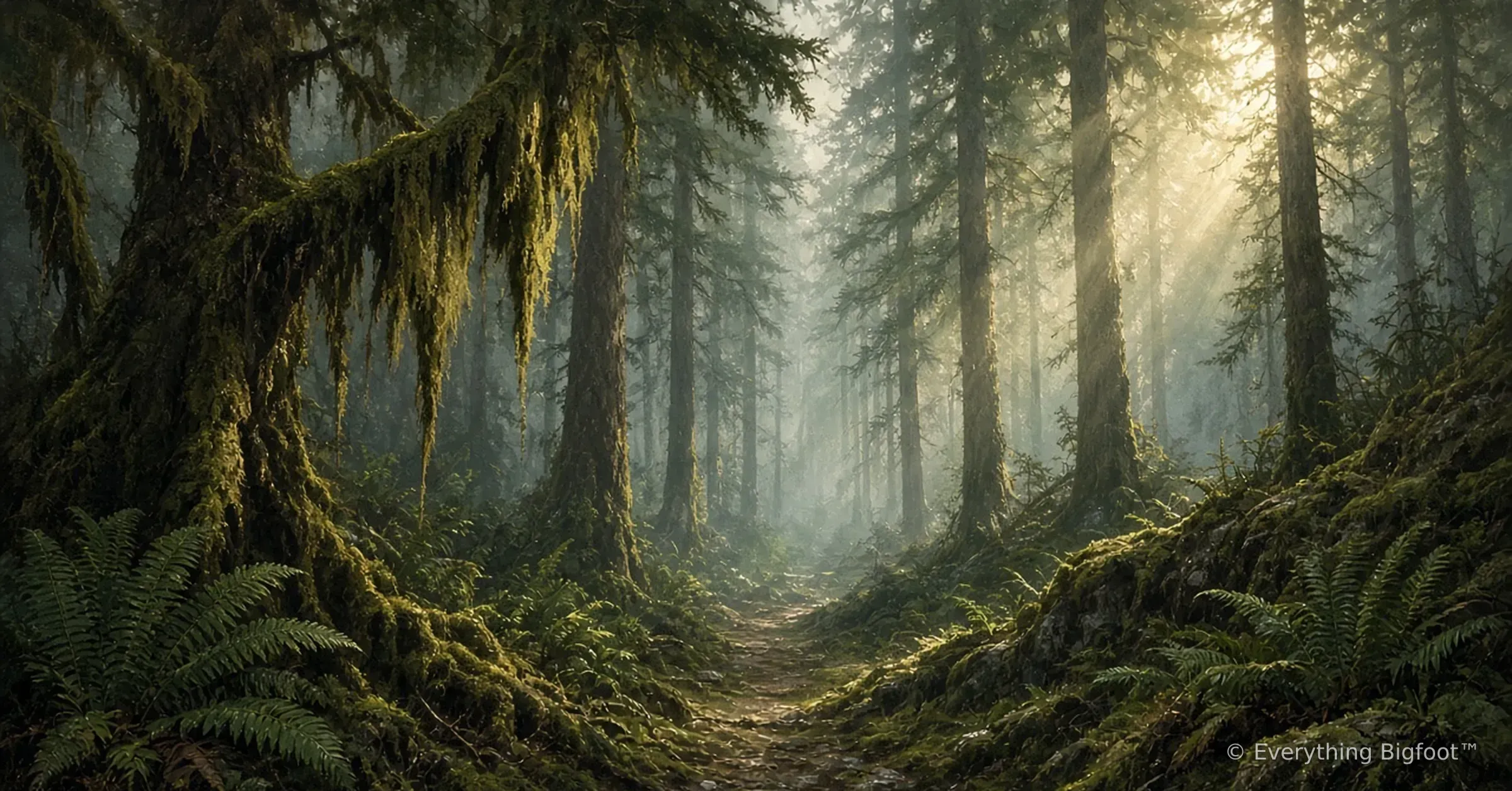
Few places look more like Bigfoot country than Oregon. Mossy old-growth forests, misty river valleys and miles of backcountry run from the Pacific all the way to the Blue Mountains. No wonder Oregon is one of the busiest Bigfoot states in the nation.
Oregon by the numbers
In the public BFRO dataset behind our sightings map, Oregon has 186 mapped reports, among the top ten states. The earliest Oregon entry dates to 1949 (mapped reports in the public dataset through 2021, not total BFRO reports).
| County | Mapped reports | Region |
|---|---|---|
| Clackamas | 18 | Mount Hood / east of Portland |
| Douglas | 14 | Umpqua country, southern Oregon |
| Umatilla | 14 | Blue Mountains, northeast Oregon |
| Lane | 14 | Central Cascades and coast near Eugene |
| Josephine | 13 | Siskiyou Mountains, southwest Oregon |
| Deschutes | 11 | East side of the Cascades near Bend |
Just below the top six are Hood River County, on the north side of Mount Hood, with 10 reports and Marion County, which runs from Salem up into the Cascades, with 8. What's striking is how spread out these are. Reports come from the wet west side of the Cascades, the drier east side, the far northeast and the southwest corner. Combined with neighboring Washington (the No. 1 state in the dataset), the Pacific Northwest is the heart of Bigfoot reporting.
When Oregon reports happen
Oregon's 186 mapped reports have a strong summer lean, much stronger than Washington's:
- Summer leads by a mile. 91 reports, nearly half, fall in June, July or August. Fall has 63, while spring (18) and winter (14) are quiet. July alone has 40 reports and August has 34. Early fall stays busy too, with 25 reports in September and 24 in October. By December, the count drops to just five.
- The 2000s were the busiest decade, with 76 reports, followed by the 1990s (36) and the 1970s (33). Only 15 date from 2010 or later.
- The split is close to even. 85 are Class A, clear-view reports, and 101 are Class B, such as sounds, tracks or a partial view.
That summer peak makes sense in a state where much of the backcountry, from the high Cascades to the Blue Mountains, is snowbound or hard to reach for months each year. When the roads open and the campgrounds fill up, the reports follow.
The Oregon Bigfoot Trap
Oregon is home to what's believed to be the only Bigfoot trap of its kind. In 1974, the North American Wildlife Research Team, a now-defunct group based in Eugene, built a 10-by-10-foot wooden box trap in what's now the Rogue River–Siskiyou National Forest, in southern Jackson County, about 3.1 miles from the California border.
The team was inspired by a local miner, Perry Lovell, who claimed to have found 18-inch human-like tracks in his garden. They kept the trap baited for six years. They caught only bears.
The trap itself is built of 2x12 planks bound with heavy metal bands and anchored to the ground with telephone poles. Bait hung from the ceiling, and pulling it was supposed to drop a metal door. It was abandoned in the early 1980s, and its door has been bolted open since 1980 for visitor safety. The site used to be remote, but since the Applegate Dam was built, a road now runs nearby.
After the trap was abandoned, the U.S. Forest Service began restoring it in 2006 through its Passport in Time program. Today it sits along the Collings Mountain trail, with its door bolted open for safety, and draws hundreds of visitors a year. At least one film has been shot on site, and Marian Place's 1974 book On the Track of Bigfoot includes photos of the trap from the year it was built.
The FBI's Oregon hair test
One of the strangest Bigfoot episodes in the federal record started in Oregon. As CNN recounted in 2026, in 1976 the FBI agreed to examine 15 hair samples from a reported Bigfoot encounter in Oregon, at the request of the Bigfoot Information Center and Exhibition. The verdict: "the hairs are of deer family origin." It's still one of the best-known examples of scientists formally testing Bigfoot evidence. For more on the science, see Is Bigfoot Real?
Museums and exhibits
- North American Bigfoot Center, Boring: Opened in 2019 by Cliff Barackman of Finding Bigfoot, at the junction of Highways 26 and 212 on the way to Mount Hood. Its website lists daily hours of 10 a.m. to 5 p.m.
- Sensing Sasquatch, High Desert Museum, Bend (2024–25): This past exhibition presented Sasquatch through the art and voices of Indigenous Plateau artists. It's a great reminder that Sasquatch traditions in the Northwest long predate the word "Bigfoot."
See all our picks in Bigfoot Museums in the USA.
Oregon Bigfoot festivals
Oregon's small towns love their Sasquatch:
- Glide Sasquatch Festival (Glide): a free festival in the Umpqua area of southern Oregon. This year's edition was held June 20, according to KQEN.
- Sasquatch Summer Fest (Oakridge): in the Cascades town of Oakridge, at Greenwaters Park. It's scheduled for July 10–11 this year, its third year.
Dates change, so check our festivals page for the latest.
Where to explore
Oregon's top counties line up with some of its best outdoor areas:
- Mount Hood National Forest (Clackamas County): The forest sits about 62 miles east of Portland and runs south from the Columbia River Gorge across more than 60 miles of mountains, lakes and streams. It is named for Mount Hood, the state's highest mountain. Clackamas County leads Oregon in mapped reports, and the North American Bigfoot Center in Boring sits on the highway that leads up to it.
- Umpqua National Forest (Douglas, Lane and Jackson counties): 983,129 acres of southern Cascades that border Crater Lake National Park, with ranger districts at Cottage Grove, Diamond Lake, North Umpqua and Tiller. Glide, home of the Sasquatch festival, is a gateway to the North Umpqua.
- Willamette National Forest (Lane County): rivers, waterfalls and deep forest east of Eugene, around the festival town of Oakridge.
- Umatilla National Forest (northeast Oregon): 1.4 million acres in the Blue Mountains, spread across Oregon and southeast Washington. It is remote, rugged and much less crowded than the west side, and Umatilla County ties for second place in Oregon's mapped reports.
- Rogue River–Siskiyou National Forest (Josephine and Jackson counties): the Rogue River and Siskiyou forests were combined in 2004 and now run from the crest of the Cascades west into the Siskiyou Mountains, covering almost 2,800 square miles. This is home of the Bigfoot Trap and a short hop from California's Bigfoot country.
Remember the basics: tell someone your plans, carry the Ten Essentials, respect private land and practice Leave No Trace. Our gear checklist has everything you need.
Plan a bigger trip
Oregon is the middle leg of our Pacific Northwest Bigfoot road trip, which runs from Mount St. Helens in Washington to Willow Creek in California. Read about Oregon's northern neighbor in Bigfoot in Washington State.
Whether you're chasing tracks or just chasing waterfalls, Oregon's forests are worth the trip. Keep your eyes open, and your camera ready.