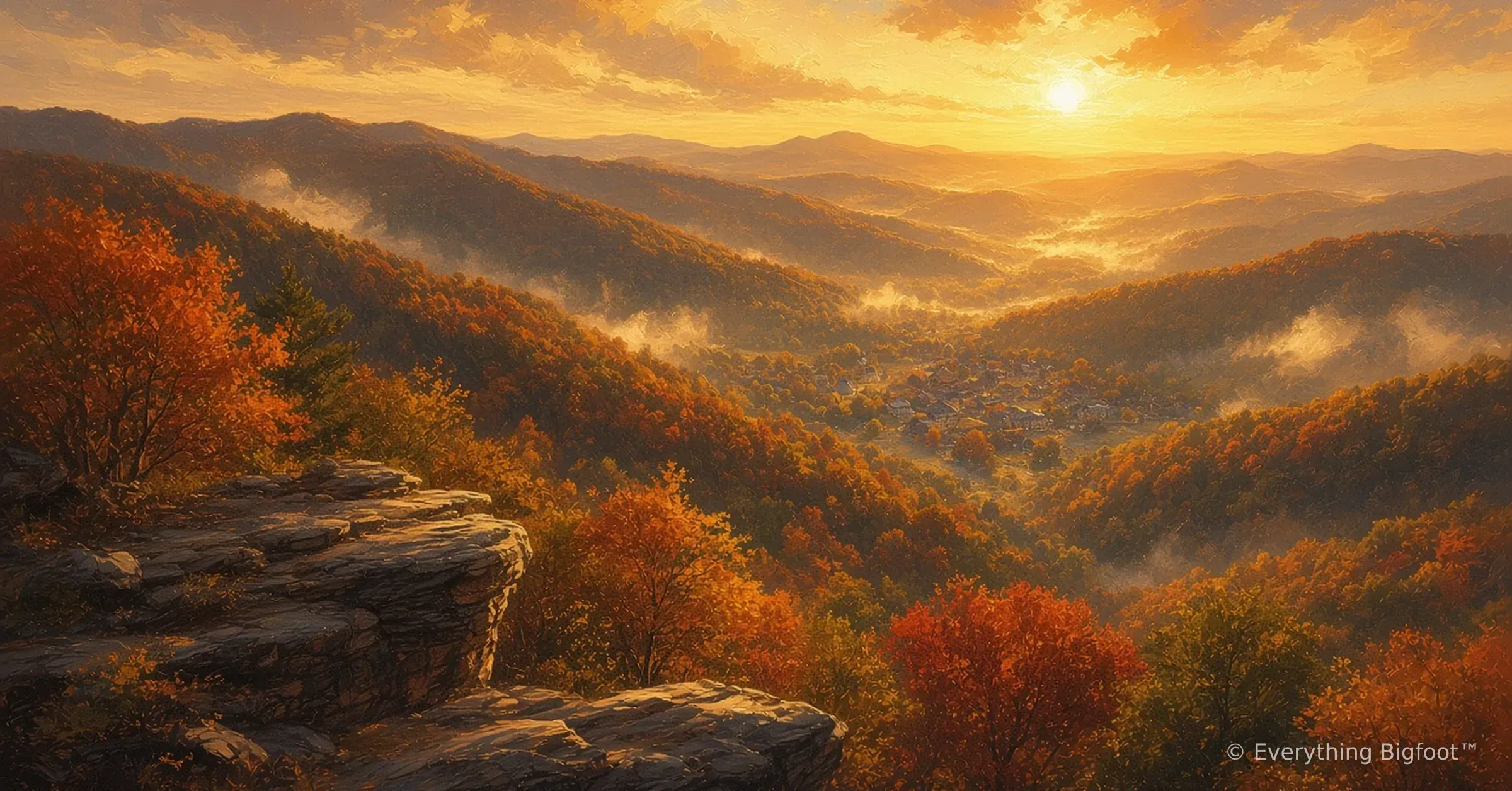
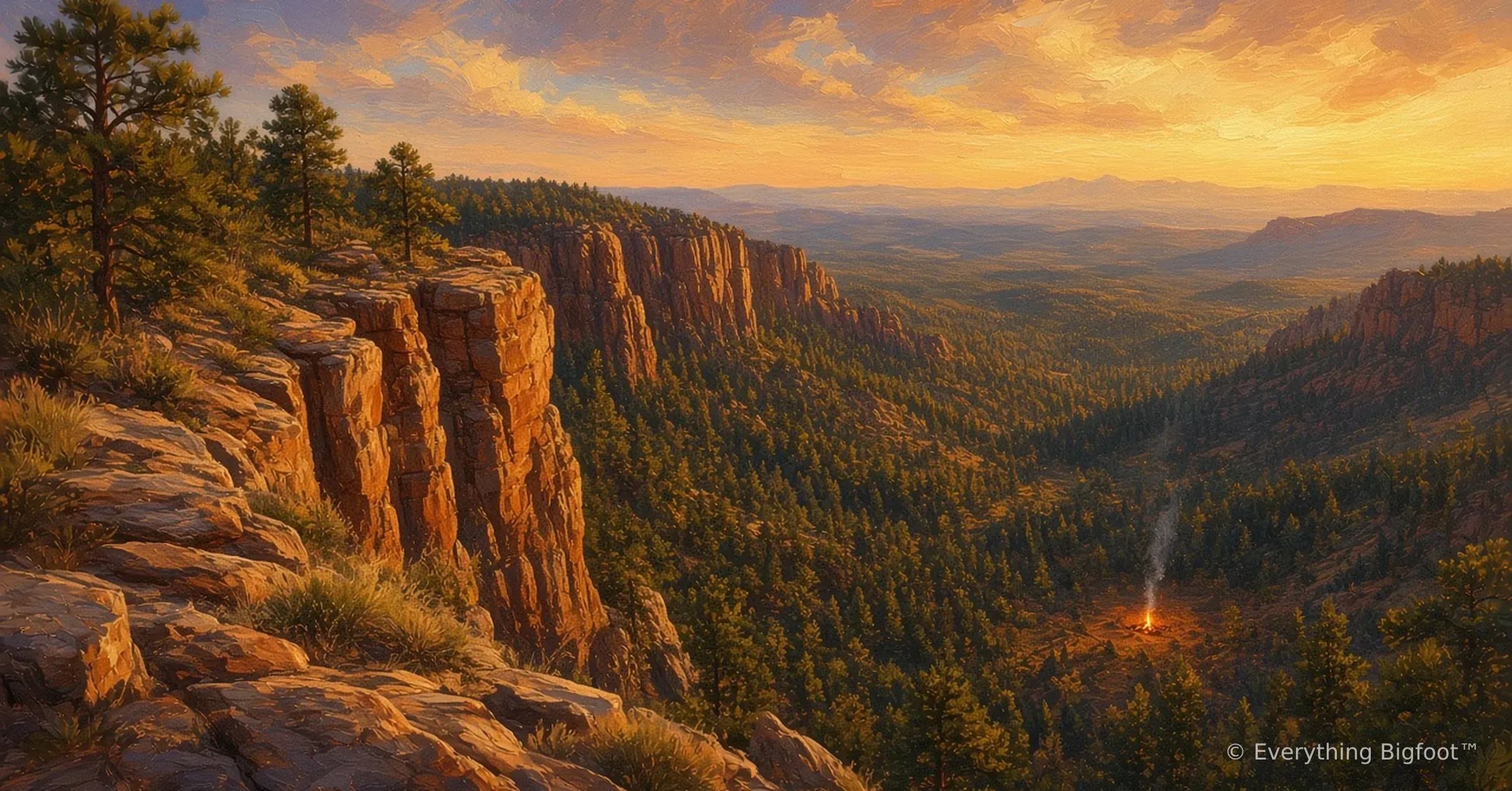
When most people picture Arizona, they think of saguaros and red rock. But stretch across the middle of the state and you'll find something different: the Mogollon Rim, a towering escarpment topped with one of the largest ponderosa pine forests in the world. Cool, green and full of elk, it's also home to the Southwest's most famous Bigfoot: the Mogollon Monster.
(Locals usually say it "MUG-ee-yon" or "MUG-ee-own." Either way, you'll fit in.)
Where is the Mogollon Monster's territory?
According to Wikipedia, reported sightings run in a big loop along the Rim country: from Prescott north to Williams, southeast to Alpine, south to Clifton, and back northwest to Prescott. That covers towns like Payson, Show Low and the White Mountains, plus a lot of national forest.
The Rim itself is a geological feature that cuts across the northern half of Arizona for about 200 miles, from northern Yavapai County east to near the New Mexico border. It forms the southern edge of the Colorado Plateau, which is why the land drops away so dramatically to the south. Below and along it sits the Tonto National Forest, the largest of Arizona's six national forests at 2,873,200 acres and the ninth largest in the country. Its elevations run from 1,400 feet in the Sonoran Desert up to 7,400 feet in the ponderosa pines of the Rim. That range, from cactus to cool pine forest in one drive, is a big part of why the Rim feels like a different world from the rest of Arizona.
What does it look like?
The legend describes:
- A bipedal creature over 7 feet tall
- Large red eyes
- Long black or reddish-brown hair covering the body, except the chest, face, hands and feet
- A smell often described as a mix of "dead fish, a skunk with bad body odor, decaying peat moss and the musk of a snapping turtle"
- Footprints around 22 inches long
Reports also describe it as nocturnal, able to mimic birds and coyotes, whistling, throwing stones from out of sight, and building nests of pine needles, twigs and leaves. Accounts say it walks with wide, inhuman strides, explores campsites after dark and lets out a "blood-curdling" scream that witnesses compare to a woman in "great distress." Some stories even claim it decapitates deer before eating them. Many accounts mention an eerie silence in the woods right before an encounter, "an appreciable stillness in the woods that commonly surrounds predatory animals," as Wikipedia's summary of the reports puts it.
The 1903 newspaper story
The oldest known report, according to Wikipedia, appeared in *The Arizona Republican in 1903. A man named I.W. Stevens described a creature near the Grand Canyon* with "long white hair and [a] matted beard that reached to his knees," a coat of gray hair and claws on its fingers. He said it "screamed the wildest, most unearthly screech."
It's a wild tale, and very different from the modern description, but it shows that strange stories in Arizona's high country go back more than a century.
Later reports
- Don Davis, a cryptozoologist, said he saw the creature during a Boy Scout trip near Payson in the mid-1940s. He described it as huge, with a square, box-like head and massive arms.
- Marjorie Grimes of Whiteriver said she saw a black, tall creature walking with long strides several times between 1982 and 2004.
- Wikipedia also notes claims from people on the Fort Apache Indian Reservation.
A campfire legend
For generations, the Mogollon Monster has been a favorite campfire story, especially at summer camps in the Rim country. One popular tale centers on a pioneer named Sam Spade who built a cabin near what's now Camp Geronimo, a Scout camp near Payson. In the story, the creature attacks Spade at his cabin, and later his son Bill and Bill's bride-to-be meet a grim end on their wedding day. Other campfire versions give the Monster different origins, such as a pioneer cursed by the spirits who goes insane. Many former campers in Arizona will tell you they first heard about the Monster around a fire there. The legend also turns up in Weird Arizona (2007), a travel guide to the state's local legends, and was noted in the American Folklore Society's Abstracts of Folklore Studies back in the 1970s.
Arizona folk singer Dolan Ellis even wrote a song called "Mogollon Monster" and used it in a campaign against littering. The idea, according to Wikipedia, was that the Monster targeted people who carelessly littered in its territory. We love that one: a Bigfoot legend helping keep the forest clean.
What skeptics say
Scientists have been doubtful. Stan Lindstedt, a professor emeritus of biology at Northern Arizona University, has said he puts the Monster "in the category of mythology that can certainly make our culture interesting, but has nothing to do with science."
Skeptics also point out that grizzly bears roamed Arizona's forests until the early 1930s, and that black bears, mountain lions and elk still live there and could explain some sightings. For a balanced look at the evidence, read Is Bigfoot Real?
Arizona by the numbers
In the public BFRO dataset behind our sightings map, Arizona has 63 mapped reports, with the earliest from 1972. The top counties line up with the high country, not the desert:
| County | Mapped reports | Includes |
|---|---|---|
| Coconino | 26 | Flagstaff, Williams, the Grand Canyon area |
| Apache | 10 | White Mountains (east) |
| Graham | 6 | Mount Graham area |
| Navajo | 6 | Show Low, Pinetop-Lakeside |
| Yavapai | 5 | Prescott |
(Mapped reports in the public dataset through 2021, not total BFRO reports.)
Coconino County alone has more than 40% of Arizona's mapped reports. Gila County, home of Payson and much of the Rim country, has 3, as does Maricopa County around Phoenix.
When Arizona reports happen
- Summer is the season. 29 of the 63 reports fall in summer, compared with 18 in fall, 9 in winter and 7 in spring. June (11) and August (10) are the busiest months, which is exactly when Arizonans flee the desert heat for the high country.
- Mostly Class B. 42 reports are Class B (distant or poor-light views, plus all sound-only reports) and 21 are Class A clear sightings. That two-to-one ratio is unusual: nationally the dataset splits almost exactly evenly between A and B.
- The 2000s were the peak, with 33 reports, more than half the state total. Thirteen date from 2010 or later. It's covered by the forests around Flagstaff, home to some of the state's best camping.
Visiting the Rim country
The Mogollon Rim makes a great summer escape from Arizona's desert heat. Popular areas include the Rim Road (Forest Road 300), Woods Canyon Lake, and the forests around Payson, Show Low and Flagstaff.
Tips:
- Watch the weather. Summer monsoon storms bring lightning and flash floods.
- Check fire restrictions. Arizona forests often have campfire bans in early summer.
- Bring layers. Elevations near 7,000 feet or higher mean chilly nights.
- Pack the Ten Essentials. See our gear checklist.
Find more regional legends like this one in Bigfoot names by state.