Fifty-four years ago today, on July 11, 1972, a small Mississippi River town in northeast Missouri got a scare it would never forget. The creature that came out of the woods that summer was nicknamed Momo, short for "Missouri Monster," and it became one of the most famous Bigfoot stories of the 1970s.
The town: Louisiana, Missouri
Yes, it's confusing: Louisiana is the name of a small river town in Pike County, Missouri, on the bluffs of the Mississippi about 90 miles north of St. Louis. In 1972, it was a quiet place of farms, woods and creeks. That changed in a single afternoon.
July 11, 1972: the kitchen window
According to accounts summarized on Wikipedia, two young boys were playing in their backyard on the rural edge of town. Their older sister, Doris, was in the kitchen when she heard them screaming.
She looked out the window and saw a massive, dark-haired, man-like creature. She said it seemed to be holding a dead dog. She described it as having a "pumpkin-shaped head" and large, glowing orange eyes.
The summer of Momo
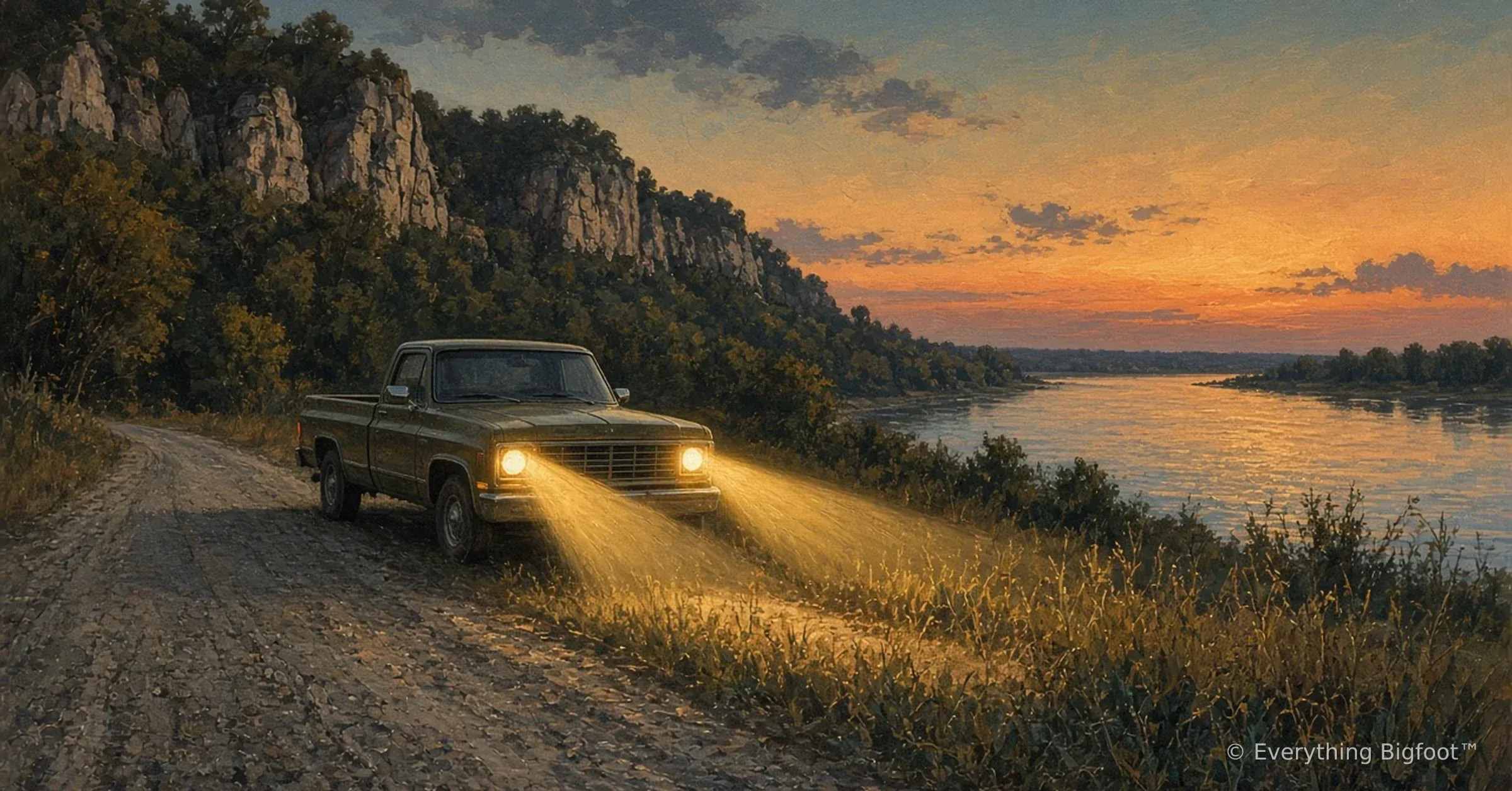
Doris's report was just the beginning. Other reports followed through that summer. The most notable came from Richard Allan Murray, the local fire chief and a member of the city council. He described seeing a massive upright creature in his headlights while driving along a creek bed.
The sightings stirred up so much worry that a 20-person posse was formed to hunt the creature. They didn't find it.
What the sightings data shows for Pike County
The public BFRO dataset behind our sightings map doesn't include the famous kitchen-window account by name, but it does have three Pike County entries, and the first one lands right in the middle of the Momo summer:
- Summer 1972: a witness reported seeing a large upright figure in Pike County (Class A, a clear sighting).
- Spring 1973: a witness reported hearing unusual sounds along a road (Class B).
- Spring 1991: a witness reported seeing a large upright figure near a campsite (Class A).
Three reports in almost fifty years isn't much, and it's a reminder of how unusual the 1972 flurry was. Whatever happened in Louisiana that summer, it didn't turn into a steady stream of reports afterward.
What did Momo look like?
The descriptions from 1972 share a few key features:
- About 7 feet tall, though at least one contemporary news report gave taller estimates
- Upright, walking on two legs like a person or an ape
- Covered in dark hair
- A terrible smell, a trait it shares with the Skunk Ape and the Honey Island Swamp Monster
- That memorable pumpkin-shaped head and glowing orange eyes
Why didn't Momo become a tourist magnet?
Here's an interesting twist. Many Southern Bigfoot legends turned into local industries. Fouke, Arkansas, built a festival and a whole identity around the Fouke Monster, and Louisiana's swamp tours love the Honey Island Swamp Monster. Wikipedia notes that Momo never became a major tourist or economic attraction in the same way.
Maybe the town just wanted things to go back to normal. Either way, Momo stayed more of a legend than a brand. That makes it feel a little more mysterious.
Momo in pop culture
Momo still got its moments in the spotlight:
- Six Flags St. Louis had a ride named after the creature that operated from 1973 to 1994.
- In 2019, the docudrama horror film *Momo: The Missouri Monster dramatized the 1972 events. Its cast includes Cliff Barackman and James "Bobo" Fay, both known from Animal Planet's Finding Bigfoot*.
- Author Lyle Blackburn dug into the case in his 2019 book *The Strange Case of the Missouri Monster*.
The case was written up almost immediately: Richard Crowe's article "Monster in Missouri" appeared in December 1972, the same year as the sightings. It has since been retold in Allan Zullo's The Ten Creepiest Creatures in America (1997) and in older books, including Marian Place's Bigfoot All Over the Country (1978) and Weird U.S. (2004). Find more great reads in our upcoming best Bigfoot books guide.
Bigfoot in Missouri: the numbers
Momo isn't Missouri's only Bigfoot story. In the public BFRO dataset behind our sightings map, Missouri has 139 mapped reports, with the earliest dating to 1954. Pike County, Momo's home, has 3.
| County | Mapped reports |
|---|---|
| Jackson (Kansas City area) | 8 |
| Pulaski (Mark Twain National Forest / Fort Leonard Wood area) | 6 |
| Crawford, Cass, Taney, Boone, Vernon | 5 each |
(Mapped reports in the public dataset through 2021, not total BFRO reports.)
Missouri's reports are spread across the whole state, from the suburbs of Kansas City to the Ozark hills around Branson (Taney County) and the river country in the east.
When Missouri reports happen
- Summer and fall tie. Missouri has 44 reports in each, plus 32 in spring and 19 in winter. October is the busiest single month (19), followed by July and November (17 each).
- The reports are recent. Missouri is one of a minority of states where the 2010s (39 reports) edged out the 2000s (38). Forty-four of its reports date from 2010 or later, which is more than California's 26 or Oregon's 15.
- Most are clear sightings. 82 reports are Class A and 57 are Class B.
- The 1970s stand out for their era. Missouri has 18 reports from the 1970s, the decade of Momo, compared with just six from the 1950s and 1960s combined.
Missouri Bigfoot country
The Ozarks are the big draw. The Mark Twain National Forest, established in 1939 and named for the Missouri-born author, covers about 3 million acres across 29 counties in the southern half of the state, in nine separate pieces. It makes up 11% of Missouri's forested land and includes 78,000 acres of wilderness. Its headquarters are in Rolla. Pulaski County, No. 2 in the state for mapped reports, sits in that country around Fort Leonard Wood, and Taney County takes in the hills around Branson.
Louisiana itself remains a small river town. It had 3,199 people in the 2020 census and sits on the Mississippi just south of Hannibal.
Missouri Bigfoot events
Missouri has two Bigfoot events on our festivals page. The Weston Bigfoot Search in Weston, near Kansas City, is a chamber-run family search held in April. The Ozark Mountain Bigfoot Conference at the Ozarks Event Center in Nixa, near Springfield, brings speakers to southwest Missouri each fall.
The legend lives on
Was Momo a Bigfoot, a bear, a hoax or a case of a whole town getting spooked during a hot summer? More than fifty years later, nobody can say for sure. But every July, when the cicadas are buzzing and the Mississippi bottoms get hot and still, it's easy to imagine something big moving in the trees along the creek.
If you visit Louisiana, Missouri, remember that it's a real town where people live, and the original sightings happened on private property. Enjoy the river views, stop at a local café and ask around. You may find someone who remembers the summer of Momo.
See how Momo compares to other regional legends in our Bigfoot names by state guide.